Why Niching Down Gets Your Agency More Clients
Corey Quinn
Founder, Deep Specialization™
Niching down doesn't mean fewer clients. Agency specialization creates clearer positioning, stronger referrals, better-fit leads, and predictable growth.
Agency owners resist specialization for one reason. They're afraid of making their market smaller.
The logic seems reasonable. If you can sell to 20 industries today and narrow to one tomorrow, haven't you just eliminated 95% of your opportunities?
Mathematically, maybe. Strategically, no.
Your addressable market isn't the same thing as your winnable market. A generalist agency can theoretically sell to almost anyone. But when buyers can't immediately understand why you're the right agency for them, that enormous market doesn't do you much good.
Niching down changes that. You become easier to understand, easier to remember, easier to refer, and easier to trust.
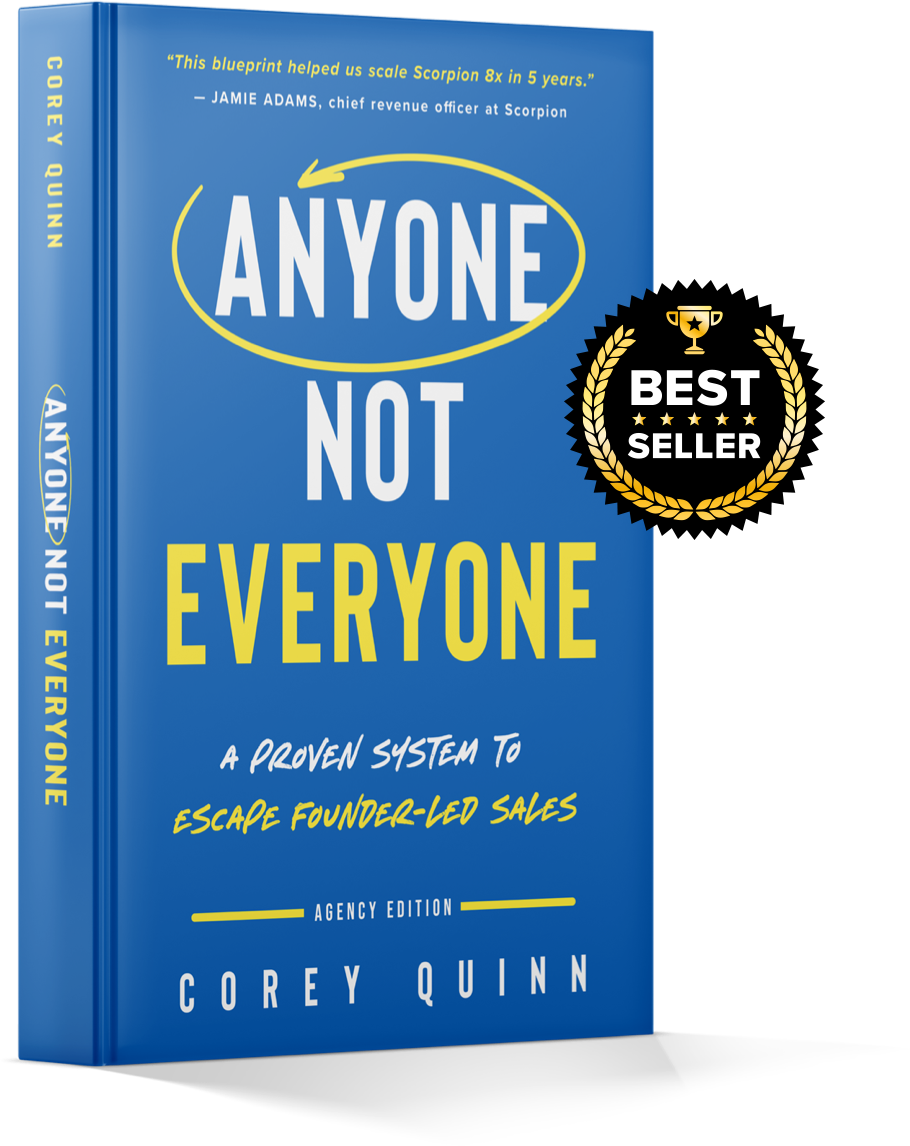
That's the specialization paradox at the heart of Anyone, Not Everyone: going narrower creates a much bigger growth opportunity. Tightly defining your market and specializing deeply helps agencies attract better-fit clients and generate more profitable revenue.
Here's why it works.
What Does Niching Down Mean for an Agency?
Niching down means deliberately narrowing the market you target instead of positioning yourself as a solution for everyone.
But there's an important distinction. Putting "We specialize in healthcare" on your website doesn't make you deeply specialized. Deep Specialization™ goes further. It aligns your market, high-value problem, positioning, offers, proof, sales process, and thought leadership around a clearly defined type of client and outcome.
Broad: "We're a full-service digital marketing agency."
Narrower: "We're a digital marketing agency for healthcare companies."
Deeply specialized: "We help multi-location dental groups increase patient acquisition through paid search and local SEO."
Now a prospect can answer three questions immediately: Is this for me? Yes. Do they understand my problem? Yes. Have they solved something like this before? Probably.
You've cut the explanation required before the sales process even starts. That's the point.
Why Agency Owners Are Afraid to Niche Down
I hear some version of this constantly: "But Corey, what happens when someone outside our niche wants to hire us?"
Underneath that question is usually a bigger fear: what if there aren't enough clients?
So the agency keeps its positioning broad. It serves manufacturers, law firms, SaaS companies, healthcare businesses, home services companies, and anyone else willing to sign a contract. Revenue feels safer because there are more potential buyers.
But being available to more buyers doesn't mean more buyers will choose you. If your positioning is broad, your messaging has to be broad too, and broad messaging creates a relevance problem. You become capable of serving everyone and compelling to no one.
Being capable of serving many clients doesn't automatically make an agency easy to understand or refer. Specialization makes it clear who you help, what problem you solve, and why your experience matters.
The Math That Actually Matters: Market Share
Here's a better way to think about niching down.
Say there are 10,000 companies in your chosen vertical. You don't need all 10,000. You don't need half. You don't even need 10%.
At 5% market share, you'd have 500 clients. That's not a small business. That's a substantial one.
In Anyone, Not Everyone, I use this exact example: 500 clients out of a 10,000-company vertical. At that 5% threshold, the agency has established real value and trust within its vertical, and it has several strong options for what comes next.
This is where agency owners get niching backward. They ask, "How many businesses will I no longer target?" The better question is, "How much of this specific market would I actually need to win to build the agency I want?"
Those are very different questions.
1. Niching Down Makes Your Agency Easier to Understand
Your prospect shouldn't need a 30-minute discovery call to understand why your agency might be relevant. But that's exactly what happens with broad positioning.
"We create innovative digital experiences that help ambitious brands accelerate growth" tells a prospect nothing. Who is it for? What problem does it solve? Why should anyone choose it?
Compare that with "We help multi-location dental groups acquire more patients." You know immediately who it's for.
Prospects don't buy what they don't understand. Specialization removes the cognitive friction and lets your positioning start selling before anyone gets on a call.
2. Niching Down Makes Your Marketing More Relevant
Generalist agencies have a content problem. One week it's marketing for law firms. The next it's e-commerce SEO. Then healthcare websites. Then B2B SaaS lead generation. Each piece might be useful on its own, but collectively there's almost no compounding authority.
A specialized agency can spend an entire year talking about the problems facing one market: industry benchmarks, buyer research, case studies, regulatory updates, growth strategies, interviews with industry leaders, market-specific playbooks, original research.
Your audience starts thinking, "These people are everywhere in our industry." That's how authority compounds, and authority creates demand.
3. Niching Down Creates Better Referrals
People refer specialists differently than they refer generalists.
Someone asks a generalist's client, "Do you know a good marketing agency?" The client says, "Yeah, I know one. They're pretty good." That's a weak referral.
Now imagine you're known as the agency for veterinary groups. Someone asks, "Do you know anyone who understands marketing for veterinary practices?" Your client thinks of you immediately. That's a much stronger referral.
Specificity makes you memorable, and it makes you easy to describe. If someone needs three sentences to explain what your agency does, you have a referral problem. If they can say "They're the agency for X," you've made their job easy. That's what good positioning does.
4. Niching Down Gives You Better Proof
Say you're a law firm evaluating two agencies.
Agency A shows you a SaaS case study, an e-commerce case study, a nonprofit case study, and one legal client. Agency B shows you five law firm case studies, benchmarks from 50 legal clients, a repeatable client acquisition methodology built for law firms, and testimonials from attorneys you recognize.
Agency B feels safer. Not because they're better marketers. Because their proof is more relevant.
Buyers aren't evaluating expertise in a vacuum. They're evaluating whether your expertise applies to their situation. Every client you win inside your niche makes the next one easier to win. That's compounding proof.
5. Niching Down Makes Sales Easier
Generalist agencies start every sales conversation from zero. They need to learn what the industry looks like, who the competitors are, how the buyer makes money, what counts as a qualified lead, what regulations matter, and what success looks like.
A specialist walks in already understanding most of that. Instead of asking "Tell me about your industry," you can ask "Which of these three problems is creating the biggest constraint on growth?"
That's a different conversation entirely. You're not qualifying an opportunity like a vendor. You're diagnosing a familiar problem like an expert.
That also cuts your dependence on the founder's personal ability to sell, which is one of the central problems Deep Specialization™ is built to solve. Vertical specialization connects directly to targeted sales and marketing and to escaping founder-led sales.
6. Niching Down Makes Delivery More Repeatable
You stop reinventing the agency every time you win a client.
Serve ten unrelated industries and every new account brings new terminology, new buyer behavior, new competitors, new integrations, new compliance requirements, new expectations. Solve similar problems for similar clients again and again, and patterns emerge instead: better discovery processes, onboarding, strategy frameworks, reporting, benchmarks, templates, playbooks, training, technology stacks.
That's operational leverage. Specialization stops being just a marketing strategy and becomes a business model advantage.
7. Niching Down Can Increase What Clients Will Pay
Generalists sell capabilities. Specialists sell confidence. There's a big difference.
If five agencies look equally capable, price becomes the easy comparison point. But if one agency has solved your exact problem dozens of times, the buyer isn't comparing identical options anymore. They're weighing the perceived risk of choosing someone else.
Once an agency builds real market penetration and trust, pricing becomes another lever. After reaching meaningful share within a vertical, an agency can choose to raise prices and stay smaller rather than chase more volume.
Specialization doesn't automatically justify premium pricing. Relevant expertise does. That's what you're building.
"But Won't I Have to Turn Away Good Clients?"
Maybe. But niching down doesn't require you to fire every client outside your vertical tomorrow, and it doesn't mean you'll never work outside that market again.
There's a difference between who you can serve and who you actively position, market, and sell to. Your agency might still take an exceptional opportunity outside its core vertical. That doesn't mean your homepage needs to speak to that buyer.
This is where discipline matters. Your positioning should reflect the market you want to dominate, not every check you've ever been willing to cash.
Niching Down Doesn't Mean Staying Small
You choose a niche to establish a beachhead. You don't have to stay there forever.
Vertical specialization is a stepping stone. Once an agency establishes itself in one market, it can expand into adjacent markets or solve more problems for the clients it already has. My former company, Scorpion, started by concentrating on attorneys and hospitals before expanding into more verticals as we scaled.
There are at least three ways to grow after you've established dominance:
Go deeper. Win more clients in the same vertical.
Go wider within the client. Solve additional problems for existing customers. Selling more services to clients you already have grows revenue without requiring new client acquisition.
Expand adjacently. Take the systems you've built into another vertical with similar problems.
Specialization isn't a prison. It's a starting point for scale.
Don't Confuse Niching With Deep Specialization
One important warning: picking an industry isn't enough.
"We work with healthcare companies." Okay. Which healthcare companies? Which buyer? What problem? What outcome? Why you? What do you understand that a generalist doesn't?
This is why I draw a hard line between niching down and Deep Specialization™. A niche gives you a market. Deep Specialization™ builds the business around that market, with your positioning, messaging, offers, proof, sales process, content, and thought leadership all pointing the same direction.
Simply selecting an industry can create a niche label without creating a real specialist advantage. That's when specialization actually becomes powerful, once everything lines up.
A Simple Test: Is Your Agency Specific Enough?
Answer these five questions:
Who specifically do you serve? Could someone identify the type of company without asking another question?
What expensive problem do you solve? Not your service. The business problem.
What outcome do you create? What changes after clients hire you?
What proof do you have? Can prospects see evidence from companies like theirs?
Why are you uniquely qualified? What knowledge, method, data, relationships, or experience makes you different?
If your answers could describe hundreds of other agencies, you're still too broad.
The Real Risk Isn't Niching Down
Agency owners often ask, "What if I choose too narrow a market?" It's a fair question. Your vertical needs enough buyers, real economics, real problems you can solve, and room to grow.
Deep Specialization™ isn't magic. Vertical specialization is not a cure-all. You still need strong fundamentals, a valuable offer, and the ability to deliver at scale.
But there's a bigger risk agency owners underestimate: staying broad for too long. You spend years competing against thousands of agencies. Your marketing stays generic. Your referrals stay inconsistent. Your sales process stays founder-dependent. And your best differentiator is still "we're really good at what we do."
So is everyone else.
Fewer Prospects. More Relevance. More Clients.
That's the paradox. Niching down reduces the number of companies you could sell to. It also dramatically improves your ability to win the companies you actually want.
Your messaging gets sharper. Your marketing gets more relevant. Your proof gets stronger. Your referrals get easier. Your sales conversations get better. Your delivery gets more repeatable. And each win makes the next one easier.
The goal isn't to be relevant to everyone. It's to become the obvious choice for someone. That's the difference between choosing a niche and building a competitive advantage around it.
That's Deep Specialization™.
What's Next?
Once you decide to specialize, the next question matters just as much: which industry should you choose?
Pick the wrong vertical and specialization creates a ceiling. Pick the right one and you can build years of growth around it.
Next read: How to Pick the Right Industry for Your Agency
Related: What Is Deep Specialization™?
Related: Generalists vs. Specialists: Which Agency Wins?
Pillar: Deep Specialization™: The Competitive Advantage Every Agency Needs
Frequently Asked Questions
Does niching down really get an agency more clients? It can. Niching down makes an agency easier for its ideal buyers to understand, trust, remember, and refer. The goal isn't to shrink the target market. It's to increase the agency's relevance and ability to win within that market.
What is an agency niche? An agency niche is a clearly defined segment of the market an agency chooses to target. Deep Specialization™ goes beyond choosing an industry by aligning positioning, services, proof, sales, and thought leadership around specific buyers and problems.
Will niching down make my agency too small? Not necessarily. A focused vertical can contain thousands of potential clients. Specialization can also become the foundation for expansion into adjacent markets once the agency has strong systems and market authority.
Should an agency only work with clients in its niche? Not necessarily. An agency can maintain focused market positioning while occasionally accepting attractive opportunities outside its primary vertical. The key is not letting exceptions dilute the agency's market-facing positioning.
What's the difference between niching down and Deep Specialization™? Niching identifies a narrower market. Deep Specialization™ goes further by aligning the agency's positioning, offer, proof, sales process, and thought leadership around a specific client and outcome.
Can a specialized agency expand into other industries later? Yes. Specialization is a stepping stone. After establishing a strong position in one vertical, an agency can deepen its services or expand into adjacent markets where its existing expertise and systems transfer.
➡️ Discover Deep Specialization™
➡️ Book a Strategy Call
About Corey Quinn
Founder, Deep Specialization™
Corey helps founder-led agencies scale through Deep Specialization™ and programmatic M&A. Former CMO of Scorpion ($20M to $200M). Author of "Anyone, Not Everyone."