From Commodity to Category Leader: How Specialized Agencies Become the Obvious Choice
Corey Quinn
Founder, Deep Specialization™
How agency specialization, positioning, and a strong point of view help you escape commodity pricing and become the go-to expert in your market.
Most agencies don't become commodities because their work is bad. They become commodities because buyers can't tell the difference.
One agency offers SEO. Another offers SEO. One builds websites. Another builds websites. Everyone talks about strategy, results, partnership, creativity, and growth. From the buyer's perspective, the agencies blur together.
And when alternatives look interchangeable, buyers reach for the easiest comparison: price. That's the commodity trap.
Escaping it takes more than better creative, a new website, or declaring that you're "different." You need to occupy a position in the market that buyers recognize and value.
Deep Specialization™ helps agencies do exactly that by combining vertical focus, buyer understanding, differentiated positioning, a distinct point of view, and market-specific sales and marketing. It draws from positioning, category design, messaging, sales, and product marketing to create a durable competitive advantage.
That's the path from being another agency in the category to becoming the agency your market thinks of first.
What Does It Mean for an Agency to Be a Commodity?
A commodity agency is easy to replace. That's the simplest definition.
The buyer sees several firms offering similar services, similar claims, similar processes, similar outcomes. Maybe one has a nicer website. Maybe another has a charismatic founder. But there's no clear strategic reason one belongs in a different class from the others.
So the conversation becomes: what do you charge, how quickly can you start, can you match this proposal. That's not where you want to compete. The problem usually isn't your capabilities. It's the buyer's perception of them.
Positioning is about establishing a distinctive place in the prospect's mind relative to competing alternatives. The goal is to occupy a position that's clear, unique, memorable, and preferable. If the buyer doesn't perceive meaningful difference, your internal belief that you're better doesn't matter much.
Commodity Agencies Sell Services
Look at most agency websites. SEO. Paid media. Web design. Branding. Content. Social. Email. Strategy. Those are capabilities. They answer "what can you do?" And buyers have dozens or hundreds of agencies that can answer that question just as well.
A stronger market position answers different questions: who are you uniquely built to help? What important problem do you understand unusually well? What makes your approach meaningfully different? What do you believe about this market that others don't?
That's where specialization changes the game.
Category Leaders Sell Relevance
"Category leader" is useful shorthand for the agency that becomes a recognized go-to expert in a defined market. I don't treat it as a separate formal framework. The goal is becoming a differentiated, trusted, go-to expert within a vertical.
That's an important distinction. You don't become a market leader by calling yourself one. The market decides. Your job is to create the conditions that make that perception possible.
Step 1: Choose a Market You Can Actually Own
You cannot become known for everything. This is where most agencies get stuck. They want a strong reputation, but they also want to preserve every possible client opportunity. Those goals conflict.
Being known requires association. When somebody hears your agency's name, what comes to mind? If it's "they're a digital agency," you have a lot of work to do. If it's "they're the agency that really understands industrial manufacturers," now you're building something.
Deep Specialization™ starts with committing to a defined vertical instead of staying broad, intentionally focusing on one to create a distinctive advantage through focus, empathy, and strategy. Category leadership starts with a category narrow enough for you to matter.
Step 2: Understand the Buyer Better Than Generalists Do
Specialization without buyer intimacy is just a label. Putting "Healthcare Marketing Agency" in your title won't automatically make you valuable to healthcare buyers.
You need to understand their fears, their priorities, their buying triggers, their failed alternatives, their terminology, their internal politics, their definition of success. Buyer research comes before positioning for exactly this reason. Understand why buyers switch, how they research alternatives, what frustrates them about the old solution, and why they ultimately choose one agency over another.
That's how you stop sounding like an outsider selling marketing services. You start sounding like someone who understands the business.
Step 3: Stop Competing in Crowded Positioning
Once you've chosen the market, don't make the next mistake: copying every specialist already there.
If every agency says "we're strategic," "we're transparent," "we're your growth partner," "we deliver measurable results," you've recreated the commodity problem inside a smaller niche.
Identify attributes buyers care about, then map yourself against competitors until you find meaningful white space, a valuable position nobody's already claimed. Specialization gets you into the right room. Differentiation gives buyers a reason to choose your seat.
Don't Try to Win Where Competitors Already Own the Mindshare
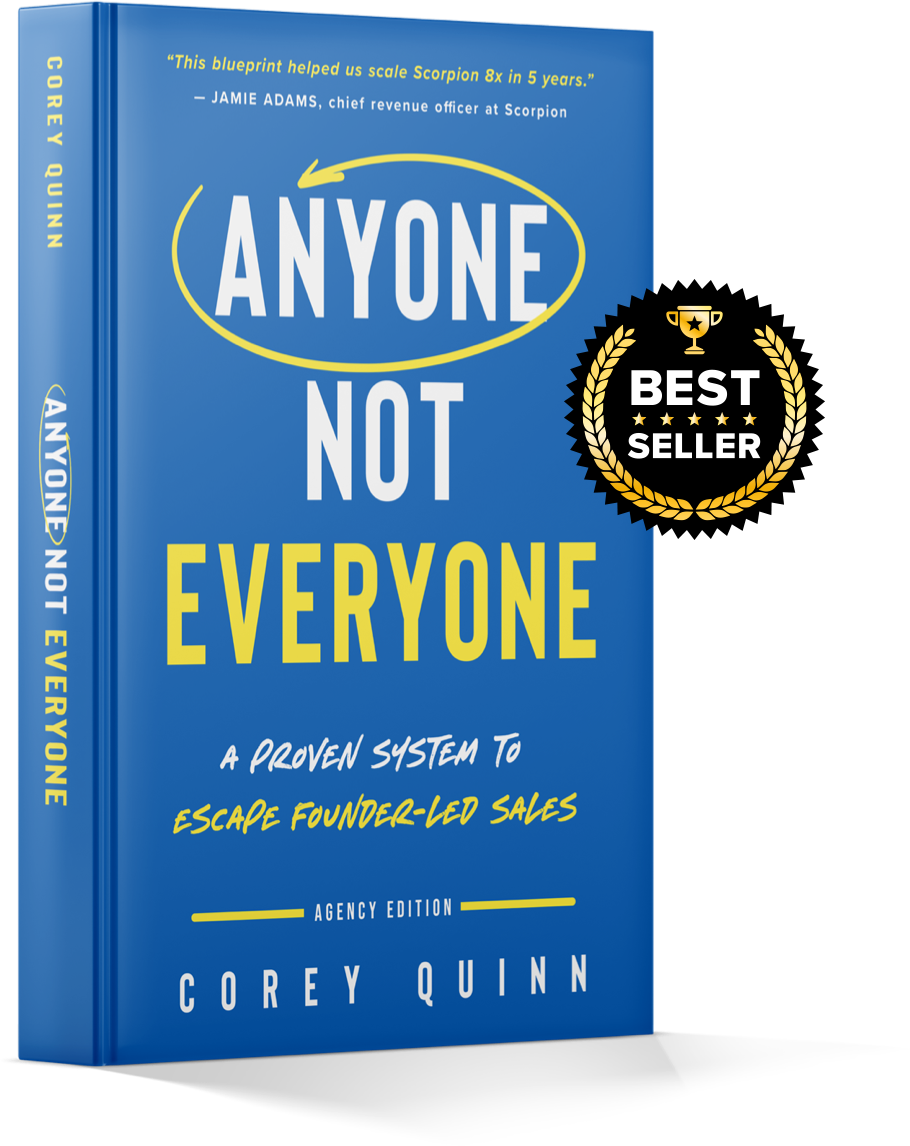
I use the Volvo example for this in Anyone, Not Everyone. Trying to compete with established performance and prestige brands would have put Volvo in an overcrowded position. Instead, safety and reliability offered clearer white space.
The lesson for agencies is simple: don't blindly compete on the same attributes everyone else emphasizes. Find the combination buyers value that you can credibly own. Your market might already have the "big agency," the "cheap agency," the "creative agency," the "performance agency," the "technical agency." Fine. You don't need to beat them at their position. You need your own.
Step 4: Develop a Point of View Competitors Can't Easily Copy
This is where many agencies stop too early. They specialize, they differentiate, then competitors notice and copy them.
Agencies naturally converge toward similar services and similar approaches over time. That's why differentiated positioning alone isn't enough in a competitive agency market. You need a strong point of view.
A point of view is your agency's distinct stance about the problem, why it exists, what's wrong with the status quo, what needs to change, and how your market gets to a better future. Think of a POV as a kind of moat, a durable competitive advantage rooted not in what the agency does, but in the change it wants to create in its vertical.
Services Are Easy to Copy. Beliefs Are Harder.
Develop a new service package and a competitor can study it, copy the deliverables, change the name, and offer something similar next quarter.
Now imagine your agency has spent five years consistently advancing a distinctive idea about how your industry's biggest problem should be solved. You've published research around it. Your founder speaks about it. Your clients repeat the language. Your methodology reflects it. Your case studies prove it. That's much harder to duplicate.
This is why a real point of view matters. You're not just selling execution. You're teaching the market how to think.
My Four-Part Point-of-View Framework
In Anyone, Not Everyone, I outline four steps for developing an agency POV: identify the big problem you solve, name the villain, describe a new future, and build a bridge to that future.
That framework moves the agency beyond "here's what we sell" toward "here's what we believe needs to change."
Identify the big problem. Not the deliverable. The larger problem affecting your market. Your functional service might increase leads, but the bigger problem could be poor access to care, outdated buyer expectations, a broken talent pipeline, industry consolidation, low trust, an ineffective status quo. The bigger the idea, the more room you have to lead a conversation instead of just advertising a service.
Name the villain. It doesn't have to be a person. It can be an outdated practice, an entrenched assumption, an inefficient model, a bad industry habit, a technology holding clients back. The purpose is contrast: this is what we're moving away from. Now your agency stands for something.
Paint a new future. Category leaders don't only criticize. They give the market somewhere to go. What should the industry look like instead? What becomes possible when the old approach disappears? What's better for the buyer, the customer, the industry? That future becomes part of your thought leadership.
Build the bridge. How does your agency help move clients from the old world to the new one? This is where your method enters the story. Your service stops being a disconnected list of activities and becomes part of a larger transformation. That's a much more powerful position.
Phaser Marketing Shows What a Bigger Point of View Looks Like
I use Phaser Marketing as an example. Phaser specializes in construction, but its point of view extends beyond selling marketing services. Founder Luke Eggebraaten articulated a broader concern about the negative perception of careers in construction and the industry's need to attract the next generation of workers. The agency's stated mission included helping change that stigma and raising awareness of the opportunities available in the trades.
Notice what happened. The conversation moved from "we market construction companies" to "we care about where the construction industry is going." That's category-leader behavior.
Step 5: Turn Your Expertise Into Intellectual Property
A market leader shouldn't just have services. It should have ideas: frameworks, language, methods, research, benchmarks, a recognizable way of solving problems.
That's one of the advantages of serving the same market repeatedly. You start seeing patterns other agencies miss, and those patterns can become intellectual property: a diagnostic, a maturity model, a scoring system, a proprietary process, a named methodology, a benchmark report.
The point isn't to invent jargon for the sake of branding. It's to codify what you've learned. Deep Specialization™ itself is an example of this: it packages my agency sales experience and disciplines like positioning, messaging, category design, and product marketing into a recognizable methodology.
Step 6: Produce Proof That Reinforces the Position
You don't become a leader through claims. You become one through evidence. Every specialist client should strengthen your market position.
Create vertical-specific case studies, industry benchmarks, buyer research, original data, testimonials from recognized organizations, before-and-after examples, market-specific frameworks.
Generalist proof says "look at all the things we've done." Specialist proof says "look at how consistently we solve this problem for companies like yours." There's a huge difference.
Step 7: Show Up Where the Market Already Gathers
You don't become a category leader from your own website alone. You have to participate in the market.
The good news is specialization makes it clear where to go: industry associations, conferences, trade publications, podcasts, LinkedIn communities, partner ecosystems. When an agency focuses on one vertical, sales and marketing get much more specific. You know which buyers to target, which conferences matter, which case studies to create, which associations to join, and which content to produce.
Leadership comes from sustained presence, not a campaign.
Step 8: Become Part of the Community, Not Just a Vendor to It
There's another level beyond understanding the industry: caring about it.
Ask yourself a powerful question: if the vertical is a community, what are you doing to improve the community itself, not just individual clients? That changes your role. Vendors ask "how can we get more clients from this industry?" Market leaders ask "how can we make this industry better?"
That might show up through research, education, advocacy, community building, industry initiatives, thought leadership, relationships. The agency stops orbiting the market. It starts participating in it.
Step 9: Create Consistency Around Your Position
Category leadership requires repetition. Lots of it. Your website, sales deck, founder content, conference talks, podcast appearances, case studies, outbound, offers, and partnerships all need to reinforce the same strategic position.
If your website says one thing, sales says another, and your founder publishes about twelve unrelated subjects, the market doesn't know what to associate with you. Consistency builds memory. Memory builds recognition. Recognition builds preference.
Step 10: Let the Market Decide That You're the Leader
This is the final part agency owners can't shortcut. You cannot declare category leadership into existence. You earn it. One successful client at a time, one useful insight at a time, one piece of proof at a time, one conference at a time, one referral at a time.
Eventually the market starts doing the positioning for you. People say "you should talk to them," "they understand this better than anyone," "they're the firm everyone in our industry knows." That's the real milestone. Deep buyer understanding and specialization is how you become the go-to expert in the vertical, and that's far more meaningful than putting "leading agency" in your homepage headline.
Commodity vs. Category Leader

The key difference isn't agency size. It's market perception.
Don't Confuse Thought Leadership With Posting More Content
Agency owners hear "become a thought leader" and translate it into "post on LinkedIn five times a week." That's distribution, not thought leadership.
Thought leadership starts with having a thought worth leading with. What do you believe? What have you learned that the market doesn't fully understand? What outdated practice needs to disappear? What new future are you advocating? Then publish around that consistently.
I make point of view a formal step in Deep Specialization™ precisely because differentiated ideas strengthen positioning in ways service descriptions alone can't.
Don't Try to Create a New Category Just to Sound Different
"Category design" can tempt agency owners into unnecessary complexity. You don't always need to invent a brand-new industry category. Sometimes becoming the clearest specialist inside an existing vertical is more valuable.
The goal is strategic distinction, not clever nomenclature. If a named methodology helps clarify your unique approach, great. If inventing terminology makes prospects more confused, stop. Clarity first, always.
The Path Is Focus → Expertise → Authority
The progression is straightforward:
Focus. Choose a market.
Expertise. Understand it more deeply than a generalist can.
Positioning. Occupy meaningful white space.
Point of view. Develop an opinion about what needs to change.
Proof. Demonstrate that your approach works.
Authority. Teach and contribute consistently.
Leadership. Become the agency the market thinks of first.
No hack. No viral post. No rebrand shortcut. Just concentrated credibility over time.
You Don't Need the Entire Market
This is another reason specialization works. You don't need to become famous to everyone. You need to become known to the right few thousand, or even few hundred, buyers. That's a much more achievable goal.
A category leader in a defined vertical can be almost invisible to the general business world and extremely valuable inside its market. That's the point of Anyone, Not Everyone. You don't need everyone's attention. You need disproportionate relevance with the people who matter.
The Goal Is to Become Hard to Replace
Commodities are interchangeable. Leaders aren't.
When clients see your agency as a source of market intelligence, a strategic advisor, a trusted industry insider, the creator of a useful methodology, a proven solver of their specific problems, replacing you becomes a very different decision.
You're no longer competing solely on services. You've built a position, a reputation, and ideally a durable competitive advantage. That's what Deep Specialization™ is designed to create.
What's Next?
Becoming more differentiated doesn't only improve marketing and sales. It can also change the economics of the agency itself. A focused agency can become easier to understand, easier to operate, less founder-dependent, and potentially more attractive to an acquirer.
Next read: How Specialization Increases Agency Valuation
Related: The Hidden Cost of Saying Yes to Everyone
Related: Positioning That Makes Selling Easier
Related: Real Agency Specialization Examples
Frequently Asked Questions
What does it mean for an agency to become a category leader?
Becoming a recognized go-to expert within a clearly defined market. The outcome of Deep Specialization™ is positioning an agency as the go-to expert in its vertical.
Why do agencies become commodities?
Agencies become commoditized when buyers perceive little meaningful difference between competing firms. Similar services, positioning, and claims make price and convenience easier comparison points.
How can an agency differentiate itself?
By understanding the vertical buyer, researching competitors, identifying valuable market white space, creating differentiated positioning, and establishing a distinct point of view.
What is a point of view for an agency?
A differentiated perspective about an important problem and the better future the agency believes should replace the status quo. A POV is a potential moat and durable competitive advantage.
What is the difference between positioning and thought leadership?
Positioning establishes how the agency should be perceived relative to alternatives. Thought leadership communicates distinctive ideas that reinforce that position and shape how the market thinks about its problems.
Does an agency need to invent a new category to become a category leader?
No. An agency can become highly recognized inside an existing vertical by owning a differentiated position, building deep expertise, developing a strong point of view, and consistently producing relevant proof.
How does Deep Specialization™ help an agency escape commodity pricing?
It concentrates expertise, messaging, proof, and market knowledge around a specific vertical. That makes the agency more relevant and less interchangeable with broad competitors, shifting the buying conversation away from generic capabilities and toward specialized value.
➡️ Discover Deep Specialization™
➡️ Book a Strategy Call
About Corey Quinn
Founder, Deep Specialization™
Corey helps founder-led agencies scale through Deep Specialization™ and programmatic M&A. Former CMO of Scorpion ($20M to $200M). Author of "Anyone, Not Everyone."