Build a business that doesn't depend on you.
Most agencies don't have a growth problem. They have an owner problem.
You built something real. Talented people, good work, clients who stay. And somehow the business needs you more every year, not less.
Free five-minute assessment. No call required.

Corey Quinn — Board advisor, author of Anyone, Not Everyone
$20M → $200M+
Scorpion revenue, as CMO
21 quarters
#1 enterprise seller, consecutive
60-person
Sales team built and led
You still generate the opportunities. You still close the important deals. You still own the key accounts, solve the delivery fires, and make nearly every decision that matters. Revenue climbs. The business gets harder to run.
That is founder-led agency growth. It works, right up until it becomes the ceiling.
Here is the part most owners miss. An agency built around the founder can grow revenue for years and still be worth almost nothing, because a buyer is not purchasing your calendar.
I scaled Scorpion from $20M to over $200M in revenue as CMO, and I was the number one enterprise seller for 21 consecutive quarters before that. The lesson was never "work harder." It was that the agencies that create real wealth are the ones designed to run, and eventually sell, without the founder at the center of everything.
That is the work. Specialize, so the market knows exactly why to hire you. Scale, so growth stops routing through your inbox. Multiply, so the business becomes an asset you own instead of a job you cannot quit.
Growth Should Buy Your Freedom, Not Cost It
Most agency owners start with a simple goal. Build a good business doing work they are proud of. Then the agency grows, and the founder becomes more essential instead of less.
From the outside, the agency looks successful. From the inside, the founder feels trapped by the thing they built.
This is not a time-management problem. You cannot calendar your way out of it. It is a design problem. The business was built to depend on one person, so it does.
Escaping founder-led agency growth means building an agency that can generate demand, convert it, deliver excellent work, and keep clients happy without the founder personally running every stage. That is a structural change, not a productivity hack.
Why Founder-Led Agencies Stop Growing
Growth rarely stalls because of one broken thing. It stalls because several problems reinforce each other, and the founder becomes the glue holding them together.
Unclear positioning
When you try to serve everyone and offer everything, the market cannot tell why you are different. So you compete on responsiveness, relationships, and price instead of expertise and outcomes. That is a losing position, and it makes every other problem worse.
Founder-led sales
You are the best salesperson in the building. You have the credibility, the scar tissue, and the authority. But when every real opportunity runs through you, your sales capacity is capped by one person's time and energy. Growth hits your calendar and stops.
An unpredictable pipeline
Referrals send you great clients. Referrals are not a system. Without deliberate business development, you swing between overloaded and anxious, and you cannot forecast either one.
Custom everything
When every client gets a different process, scope, and team, delivery becomes impossible to manage and even harder to scale. You are running a new company on every engagement.
Thin leadership
As the team grows, informal communication and founder-led decisions quit working. Without clear accountability and real managers, you stay the default escalation point for everything.
Low financial visibility
Revenue growth hides weak margins, poor utilization, and underpriced work. The agency gets bigger without getting healthier, and nobody notices until it hurts.
Fix one of these in isolation and the others pull it back. That is why point solutions fail. You have to change the design.
Specialize. Scale. Multiply.
I built it to take an agency from founder-dependent to valuable, in that order. Each stage earns the next.
Specialize
Deep Specialization™ is the highest-leverage decision an agency owner can make, and the one most owners avoid. Specialization feels like subtraction, because it is. You narrow who you serve so the market immediately understands why to hire you. That is not smaller. That is sharper.
Deep Specialization™ connects four things
Get this right and it improves far more than your marketing. Lead quality goes up. Sales conversations get easier. You price with confidence. Delivery gets efficient because you are solving a problem you have solved before. Referrals sharpen. And enterprise value rises. Focused agencies sell for more.
You become the obvious choice for the right market.
Scale
Once you know who you serve, you build the machine that grows without you. Scale is where you replace yourself, function by function. It rests on four systems.
A repeatable sales system
Your agency should not run on referrals, networking, and your personal relationships alone. It needs a defined ideal client, a focused prospect list, authority-building content, disciplined outbound and follow-up, clear pipeline stages, and honest forecasting. The point is not to remove you from sales tomorrow. It is to make sales a system instead of a personality.
Productized expertise
Endless customization creates fuzzy scopes, inconsistent delivery, and constant pricing pressure. Productizing means building a repeatable method for one problem: clear scope, defined milestones, a credible outcome. The more clearly you can explain how you create value, the easier that value is to sell, deliver, and improve.
Leadership beyond you
Growth stays fragile while you are the only real decision-maker. You need functional leaders with clear roles, real decision rights, defined expectations, and a consistent operating rhythm. You do not disappear. Your role changes. You move from solving today's problem to setting direction.
Financial visibility
You cannot scale what you cannot see. Margins, utilization, pipeline coverage, and client health have to be visible and watched, so growth makes the business healthier instead of just busier.
Multiply
Revenue is not the goal. Ownership is.
This is where most agency advice goes quiet, and where the real money lives. A great agency produces healthy profit, predictable cash flow, and reliable delivery that no longer depends on the founder. That combination is what turns a job into an asset.
Multiplying means building enterprise value on purpose. The indicators that matter to a buyer, and should matter to you long before there is a buyer, include gross margin, operating profit, revenue concentration, client retention, recurring revenue, sales conversion, average client value, leadership depth, and how involved the founder still has to be.
Watch those numbers and you learn the truth about your agency: whether it is just getting busier, or becoming worth something.
Real wealth for agency owners does not come from grinding revenue for another year. It comes from equity, ownership, and eventually an exit on your terms.
The Four Stages of Founder-Led Agency Growth
Different stages call for different decisions. Most frustration comes from running a stage-four playbook while stuck in stage two.
Stage 1: Founder-Driven
You win the clients, lead the work, and hold the relationships. The priority is proving demand and building a reputation.
The core challenge: The business and the founder are the same thing.
Stage 2: Team-Supported
You hire, and you delegate delivery. Revenue grows, but you still own sales, strategy, and every major call.
The core challenge: You delegated tasks without building systems or accountability underneath them.
Stage 3: System-Led
You develop repeatable offers, a structured sales process, stronger managers, and consistent delivery.
The core challenge: Replacing the knowledge in your head with capability the organization owns.
Stage 4: Leadership-Led
You have capable leaders, financial clarity, predictable demand, and real distance from the day to day.
The core challenge: Protecting focus while you keep growing profit and enterprise value.
The right move depends on your current constraint, not your revenue target. Two agencies at the same revenue can need opposite things.
What It Looks Like When It's Working
Clear market position
Prospects know who you serve, what you solve, and why your approach is different.
Consistent demand
Multiple channels create qualified opportunities. Referrals are a bonus, not the whole plan.
A repeatable sales process
Opportunities move through defined stages with real qualification, follow-up, and forecasting.
Stronger pricing
You sell expertise and business outcomes, not hours and deliverables.
Efficient delivery
The team runs a clear method with defined roles and milestones.
Leadership beyond the founder
Managers decide, solve, and hold performance without escalating everything to you.
Better financials
Growth is backed by healthy margins, clean forecasting, and stronger cash flow.
Founder freedom
You spend your time on the highest-value work, not every proposal and fire drill.
Where Should You Start?
Most owners try to fix growth by adding activity. More content, another salesperson, new services, more events, another software platform, one more campaign.
Activity does not fix a broken growth system. It just adds cost and noise.
Start by finding the one constraint creating the most friction. Ask yourself:
- Is my positioning actually clear?
- Am I attracting the right clients?
- Is the pipeline consistent, or feast and famine?
- Does sales still depend on me?
- Are my offers easy to understand and easy to buy?
- Is delivery repeatable?
- Are my margins strong enough?
- Can my leaders decide without me?
- Would this agency keep running well if I stepped back for a month?
The real constraint is usually not the loudest one. A sales problem is often a positioning problem. A profitability problem is often a customization problem. A leadership problem is often unclear decision rights.
Growth starts with an honest diagnosis. That is always step one.
You can run that diagnosis right now. The Agency Growth Score is a free five-minute assessment. It scores your positioning, lead generation, and sales process, then points you to the one constraint to fix first.
How I Help Agency Owners Escape Founder-Led Growth
I am a board advisor to founder-led agencies. I work with owners who want more predictable growth, less dependency on themselves, and a business that becomes more valuable every year.
My background is operating, not theory. I scaled Scorpion from $20M to over $200M as CMO, built and led a 60-person sales team, and was the top enterprise seller for 21 straight quarters. I wrote Anyone, Not Everyone on why specialization is the foundation of agency growth. Now I bring that experience to a small number of founders as an advisor, and often as an equity partner in the outcome.
Depending on where your agency is, the work can include
- Clarifying your positioning with Deep Specialization™
- Sharpening your offer so it is easy to buy
- Building a repeatable sales system so growth stops running through you
- Developing leadership so decisions do not all escalate to you
- Improving profitability and financial visibility
- Preparing the agency for a future exit on your terms
I am not chasing growth at any cost. The goal is an agency that runs better, gives you your life back, and becomes worth more every year.
Agency Growth Resources
Practical guidance for building an agency that grows without you.
Why Most Agencies Plateau at $1M–$5M
Why so many agencies hit a growth ceiling, and what has to change to move past it.
Read the ArticleFounder-Led Sales Is Costing You Growth
How founder dependency caps your sales capacity, and how to build a system that does not.
Read the ArticleHow to Build a Predictable Agency Sales Pipeline
A consistent process for generating, qualifying, following up on, and converting opportunities.
Read the ArticleWhy Deep Specialization™ Drives Faster Agency Growth
How focused positioning lifts demand, pricing, delivery, and referrals at the same time.
Read the ArticleHow AI Rewards Specialized Agencies
Why AI widens the gap between focused agencies and generalists, and how to end up on the right side of it.
Read the ArticleFrequently Asked Questions
Build an Agency That Works Without Consuming You
Your agency should create opportunity, not permanent dependence. With clear positioning, a repeatable sales system, productized delivery, real leadership, and financial discipline, the business can grow without you at the center of everything.
Build an agency that is easier to run, more profitable, and worth more every year. Then it is your choice whether you ever sell it.
“Is this a good fit for my agency?”
I partner with founders who want to build something meaningful, not just a busier agency, but a stronger, more scalable business.
You’re likely a strong fit if:
- You’re generating $1M–$20M+ annually
- You want to lead your market, not blend into it
- You’re thinking about long-term scale, not short-term tactics
- You want a growth engine that doesn’t rely on you
- You value clarity over complexity
- You’re open to advanced growth levers, including acquisitions
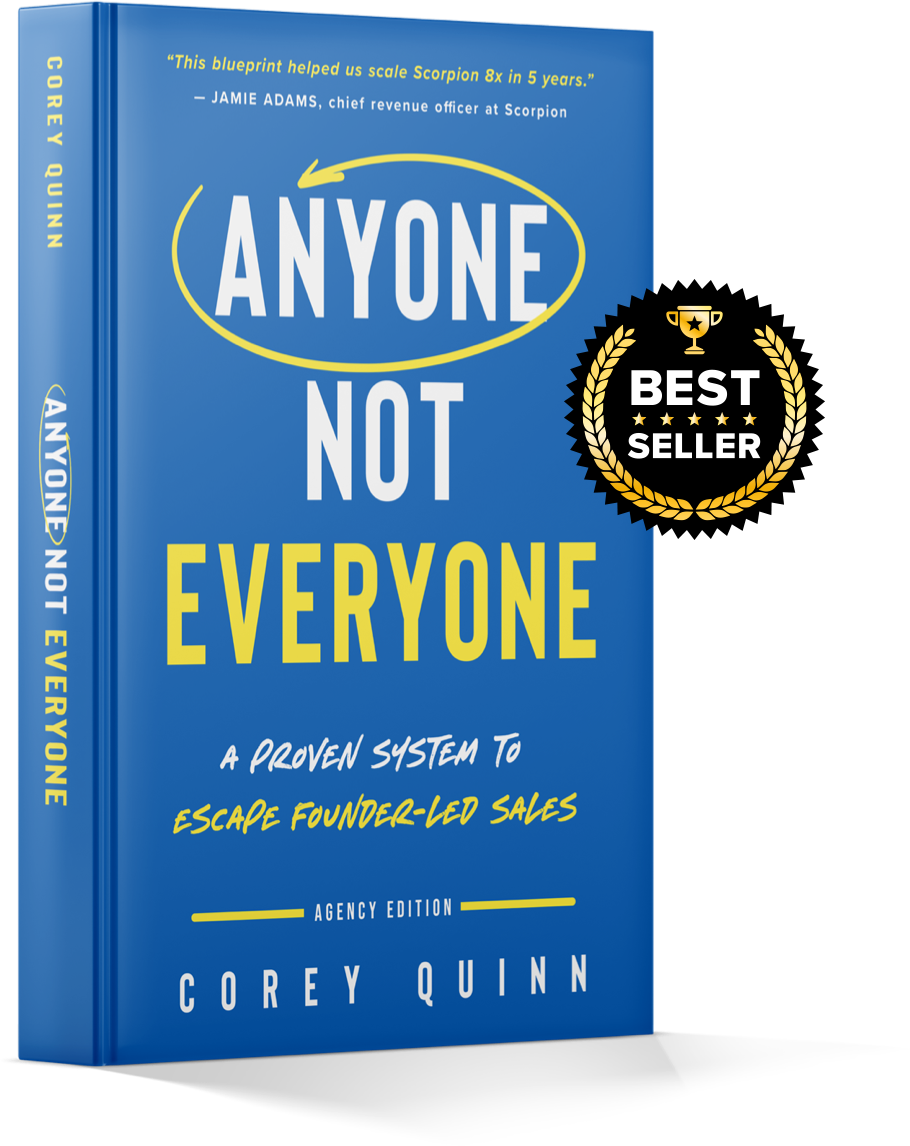
Escape Founder-Led Sales With My Free Book
My bestselling book Anyone Not Everyone reveals the positioning and outbound system that helps founder-led agencies create predictable, scalable growth.
Endorsed by Aaron Ross, Alan Dibb, Dr. Benjamin Hardy, and many other top thinkers in the agency world.