Positioning That Makes Selling Easier
Corey Quinn
Founder, Deep Specialization™
How stronger agency positioning reduces sales friction, improves differentiation, and helps prospects understand why they should choose you.
Most agency owners think sales gets easier when they hire better salespeople.
Sometimes. But often the salesperson isn't the real problem. The positioning is.
If prospects don't quickly understand who you help, what you help them do, and why you're different, your sales team has to explain all of that manually, on every call, in every proposal, in every follow-up. That's expensive.
Strong agency positioning does some of the selling before the conversation starts.
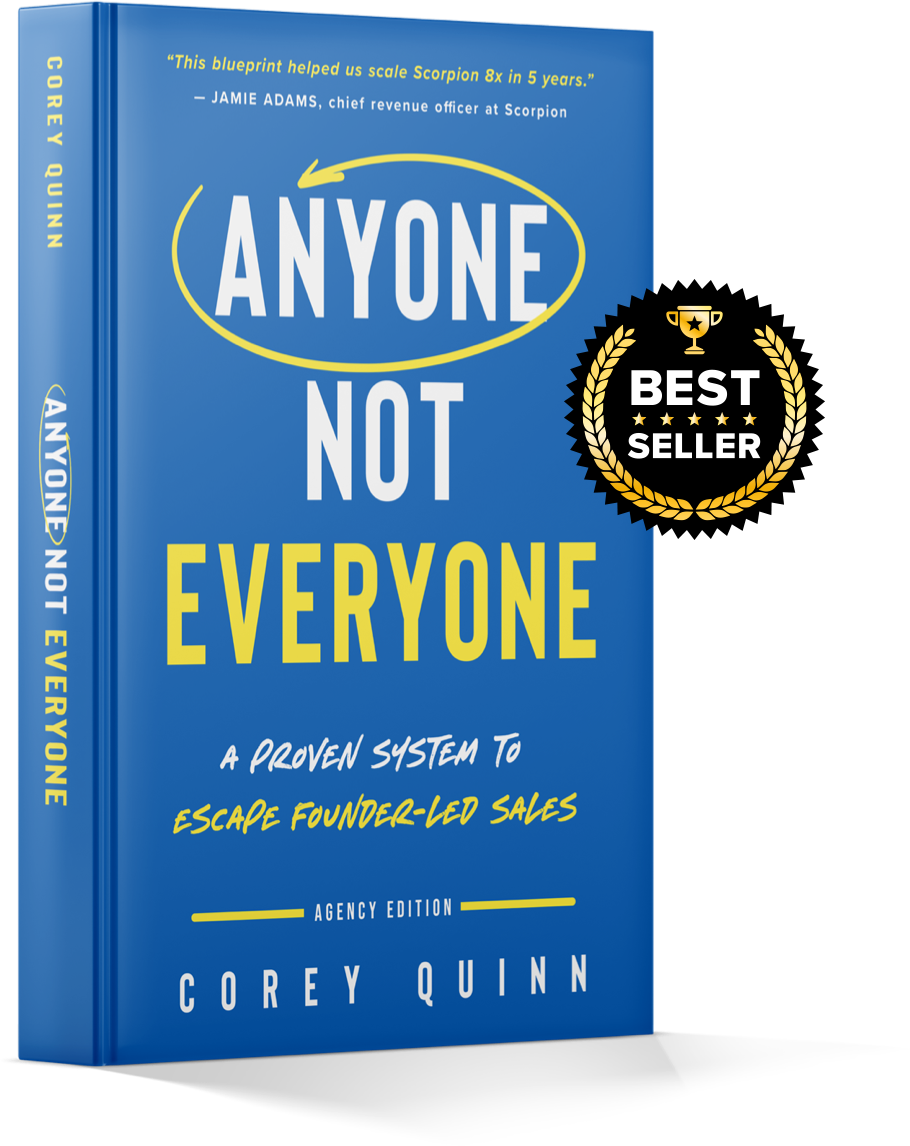
In Anyone, Not Everyone, I define positioning as deliberately establishing a distinctive place for your agency in the mind of the target client relative to competing options. The goal is to become clear, memorable, and preferable, not simply competent. That's what makes sales easier.
What Is Agency Positioning?
Agency positioning is how your ideal buyer understands your agency compared with every other option available to them. Not how you describe yourself. How they perceive you.
That distinction matters. You can spend weeks writing a clever tagline, but if a buyer still thinks "they seem like every other agency," your positioning failed.
Positioning isn't your logo. It isn't your mission statement. It isn't a list of services. It's the place you occupy in the buyer's mind, and it's based on buyer perception, not your own description of what you do.
Why Weak Positioning Makes Sales Harder
Picture two agencies.
Agency A says: "We are a full-service digital agency helping ambitious brands achieve transformational growth."
Agency B says: "We help restoration companies generate leads by combining speed-to-results with done-for-you marketing."
Agency B is easier to understand. A buyer can immediately see who it's for, what it does, and what makes the approach different. Agency A might be just as talented, maybe more talented, but the buyer has to work harder to figure out why it's relevant.
That's the hidden cost of weak positioning. Your sales team has to fill in the gaps your marketing left behind.
Good Positioning Reduces Explanation
One of the clearest signs of weak positioning is how much explanation it takes. If every sales call opens with a ten-minute history lesson about what your agency does, who you work with, what makes you different, and why your approach works, your positioning isn't doing enough.
Strong positioning creates recognition before the call. The prospect arrives already thinking "these people work with companies like mine," then "they understand the problem I'm dealing with," then "their approach sounds different from the alternatives."
Now you're not starting from zero. You're starting with relevance.
Sales Gets Easier When Buyers See Themselves
This is why Deep Specialization™ matters. Before you develop strong positioning, you need a deep understanding of your vertical buyer.
My buyer research process focuses on five things: the problems buyers had with their previous solution, the rational and emotional consequences, what finally triggered a change, how they researched alternatives, and why they ultimately chose your agency.
That information becomes positioning fuel. Buyers don't care about everything your agency can do. They care about the few things that matter to their decision. The more accurately you reflect their needs, desires, and fears, the more relevant your marketing becomes.
Stop Positioning Around Generic Agency Claims
Here's where agencies get stuck. They list what they believe are differentiators: "We care." "We're strategic." "We're transparent." "We're results-focused." "We're a true partner."
Everyone says those things.
My vertical positioning process starts by identifying attributes that actually matter to the buyer: speed to results, proactive support, specialization, custom solutions, transparency, original thinking, done-for-you service.
The goal isn't to pick attractive-sounding attributes. The goal is attributes that are both valuable to the buyer and distinctive relative to competitors. That's where positioning gets interesting.
Find the White Space
My framework uses a simple concept: white space.
Map your agency and your competitors across two attributes buyers care about. Maybe speed vs. customization. Strategic depth vs. implementation support. High-touch service vs. automation. Short-term results vs. long-term growth.
If every competitor occupies the same corner, don't squeeze in beside them. Find a position the market values that hasn't already been claimed.
I use Volvo to illustrate this in Anyone, Not Everyone. Rather than compete with prestige and performance brands in an already crowded position, Volvo built around safety and reliability, attributes that gave it clearer white space.
That's exactly how agencies should think. Don't ask "what do our competitors say?" Ask "what valuable position can we credibly own?"
My Four-Step Vertical Positioning Process
This doesn't need to take weeks.
Step 1: List the attributes buyers care about. Pull from buyer interviews, competitive research, your service model, and your experience with clients. Build a list of 10 to 20 attributes without worrying about polishing the language yet. You're trying to identify what buyers genuinely value: faster implementation, industry expertise, hands-on strategy, done-for-you execution, senior-level access, proprietary technology, predictable reporting, long-term growth focus, conversion expertise, specialized onboarding.
Step 2: Map your agency against competitors. Choose two attributes. Put one on the X-axis, one on the Y-axis. Plot your agency and your main competitors and see where everyone clusters. If five agencies all position themselves as high-touch strategic partners, saying you're a high-touch strategic partner isn't differentiation. It's table stakes. Try different attribute combinations until you find a real gap, not a manufactured one.
Step 3: Choose two attributes you can own. The best positioning combines buyer relevance with competitive separation: your clients care, you have proof, competitors aren't already dominant, and your business can consistently deliver. That last point matters. Don't position around speed if your projects are routinely late. Don't claim high-touch service if clients rarely see senior leadership. Positioning creates expectations. Delivery has to support them.
Step 4: Create a clear positioning statement. Use this structure: We help [Vertical] with [Service] by blending [Attribute 1] and [Attribute 2].
"We help restoration companies with lead generation by blending speed-to-results and done-for-you marketing."
"We help multi-location healthcare groups grow patient acquisition by blending local-market expertise with centralized performance strategy."
"We help B2B manufacturers generate qualified pipeline by blending deep industry expertise with account-based demand generation."
The formula isn't meant to win a copywriting award. It's meant to create clarity. Polish the language later.
Your Positioning Statement Is Not Necessarily Your Tagline
Your positioning statement is primarily a strategic guide. It helps your team make consistent decisions about website messaging, sales decks, proposals, case studies, content, outbound, partnerships, and offers.
It should guide your agency's messaging. It doesn't have to double as your external tagline, and it should get tested and refined over time. Don't obsess over a perfect first draft. Get it clear, put it into the market, learn, refine.
Positioning Makes Discovery Calls Better
Weak positioning creates basic discovery calls: "What does your company do?" "Who are your customers?" "What challenges are you facing?" Fine questions, but a specialized agency should already know a lot of that context.
Strong positioning lets your sales conversations start deeper. Instead of "tell me about your industry," you can say "we typically see one of three problems when multi-location groups reach this stage. Which one are you dealing with?"
Now you're demonstrating expertise. The prospect spends less time educating you. You spend more time diagnosing.
Positioning Makes Your Salespeople More Credible
Founder-led agencies often have a hidden sales problem. The founder understands the market, has the stories, knows the language, and can improvise. Then the agency hires a salesperson and expects them to reproduce years of intuition overnight.
Clear positioning makes that knowledge transferable. Your salesperson knows who the ideal buyer is, what they care about, what problems matter, how you're different, which proof to use, and what language resonates.
Now the sales process doesn't depend entirely on the founder being in the room. Deep Specialization™ ultimately helps founder-led agencies move away from founder-dependent sourcing and closing, and deep client understanding paired with differentiated positioning is what gets you there.
Positioning Also Tells You What Not to Sell
Strong positioning creates boundaries. That's a feature.
If your position is built around long-term organic growth, the prospect demanding guaranteed results in 30 days probably isn't a fit. If your position is high-touch strategic work, a buyer shopping for the cheapest execution team isn't a fit.
Good positioning filters. It helps the right buyers lean in and the wrong buyers opt out. That saves your sales team time.
Don't Build Positioning by Copying Competitors
Study competitors, but not so you can imitate them. Research competing options to understand how buyers make decisions and how alternatives are positioned. Just don't get so competitor-focused that you start making reactive decisions disconnected from actual client problems.
Study competitors to see where they're strong, what claims they own, where the market is crowded, and what they're ignoring. Then turn back to the buyer. Your positioning should come from the intersection of what buyers value, what competitors already own, and what you can credibly deliver better or differently.
Your Point of View Makes the Position Stronger
Positioning answers "why should this buyer consider us?" A point of view goes deeper: "what do we believe about their problem that others don't?"
I describe a point of view as a differentiated stance on a problem and solution, a durable competitive advantage that helps create a moat around the agency.
Agency features are easy to copy. A competitor can copy your package, your pricing structure, your headline, even your service model. It's much harder to copy a well-developed belief about how the market should work.
That's why the strongest agency positioning isn't "we serve dentists." It's closer to "we serve dentists, and here's what we believe dental groups are getting wrong about patient acquisition." Now you have something worth talking about.
Five Signs Your Agency Positioning Is Making Sales Harder
You probably have a positioning problem if prospects regularly ask "so what exactly do you do," your website could describe hundreds of agencies, salespeople need the founder to explain why the agency is different, prospects compare you mainly on price, or your proposals spend pages establishing basic relevance.
If those sound familiar, don't add another lead-generation channel yet. Fix the positioning first. More traffic to unclear positioning just creates more confused prospects.
A Simple Positioning Test
Give your homepage to someone who fits your target market. Let them look at it for five seconds. Then ask: who is this agency for? What problem does it solve? What makes it different?
If they can't answer those three questions, your positioning isn't clear enough. Every section of your messaging should make it clear what something is, who it's for, and why it matters. Prioritize clarity over cleverness. Clarity wins, especially in sales.
Positioning Doesn't Close Deals. It Removes Friction.
A great position won't fix bad delivery, weak sales skills, poor follow-up, or an offer nobody wants. But it makes every one of those activities easier.
Your marketing attracts more relevant prospects. Your salesperson starts with more credibility. Your case studies feel more applicable. Your proposals need less explanation. Your referrals get easier to make. And your prospects spend less time asking "why you?"
That's what positioning should do. It doesn't replace selling. It makes selling easier.
What's Next?
Strong positioning tells buyers where you fit. But the agencies that become category leaders go one step further. They develop a clear point of view about the market and consistently communicate it.
Next read: Real Agency Specialization Examples That Worked
Related: How to Pick the Right Industry for Your Agency
Related: Why Niching Down Gets You More Clients
Related: Generalists vs. Specialists
Frequently Asked Questions
What is agency positioning? Agency positioning is the deliberate process of establishing a distinct place for your agency in the target buyer's mind relative to competing alternatives. Effective positioning makes the agency easier to understand, remember, and prefer.
How does positioning make sales easier? Strong positioning gives prospects context before the sales conversation begins. They understand who the agency serves, what it does, and why it's relevant more quickly, which cuts the basic explanation required during sales.
How do you create a positioning statement for an agency? Four steps: list buyer-valued attributes, map those attributes against competitors, choose two attributes that create meaningful white space, then use the formula: We help [Vertical] with [Service] by blending [Attribute 1] and [Attribute 2].
What makes agency positioning different? Differentiated positioning occupies valuable white space in the market rather than repeating claims competitors already own. The difference has to matter to buyers and be something the agency can credibly deliver.
Is a positioning statement the same as a tagline? No. A positioning statement is primarily a strategic guide for messaging and marketing. It may be used externally, but it doesn't have to function as the agency's tagline.
How often should an agency change its positioning? Treat it as an ongoing process of validation and refinement, not a one-time exercise. Test the position with real buyers and update it as the agency and market evolve.
Explore Deep Specialization™
Book a Strategy Call
About Corey Quinn
Founder, Deep Specialization™
Corey helps founder-led agencies scale through Deep Specialization™ and programmatic M&A. Former CMO of Scorpion ($20M to $200M). Author of "Anyone, Not Everyone."