How Specialization Increases Agency Valuation
Corey Quinn
Founder, Deep Specialization™
How agency specialization can improve margins, retention, founder independence, recurring revenue, and enterprise value.
Agency owners often think about specialization as a marketing decision. It isn't. It's also a valuation decision.
A focused agency can become easier to sell, easier to scale, more profitable, less dependent on the founder, and more attractive to a buyer. A more focused, systemized agency carries greater enterprise value because it's easier to scale, more profitable, and more attractive to buyers.
That's the part many founders miss. Deep Specialization doesn't just help you win better clients today. Done well, it helps you build a better asset for tomorrow.
Revenue Is Not the Same as Value
Let's start with the biggest misconception. A $10 million agency isn't automatically more valuable than a $5 million agency.
Revenue matters, but buyers care about what sits underneath it: gross margin, operating profit, revenue concentration, client retention, recurring or predictable revenue, sales conversion, average client value, leadership depth, founder involvement. Those are the indicators that tell you whether an agency is simply getting busier or actually becoming more valuable.
You can grow revenue while increasing risk. Or you can build a business with stronger economics, better systems, and less key-person dependence. Buyers notice the difference.
Why Buyers Care About Specialization
A buyer isn't just asking "how much revenue does this agency generate?" They're asking how predictable that revenue is, how defensible the agency's position is, how dependent the business is on the founder, whether they can scale what already works, whether clients will stay after the acquisition, and whether the company has a repeatable advantage.
Specialization can strengthen several of those answers at once. That's why it influences enterprise value indirectly, even if no buyer ever gives you a line item called "specialization premium."
1. Specialization Can Improve Pricing Power
Generalists are easier to compare. When buyers see several agencies offering similar services, price becomes the obvious comparison point. Specialists have a better chance of shifting the conversation toward expertise and business outcomes rather than competing on deliverables or hourly effort.
Why does that matter for valuation? Stronger pricing improves margins, profit, cash flow, and ultimately the quality of earnings. Revenue is nice. Profitable revenue is better.
2. Specialization Can Make Delivery More Efficient
When your agency repeatedly solves similar problems for similar clients, delivery becomes easier to systemize: repeatable onboarding, defined milestones, standard reporting, proven methodologies, better staffing models, reusable intellectual property.
Productized expertise reduces fuzzy scopes, inconsistent delivery, and pricing pressure by creating a repeatable method around one problem. Buyers don't want to acquire chaos. They want something they can understand, operate, and scale. The more repeatable the delivery model, the more the business looks like an asset instead of a collection of custom projects.
3. Specialization Can Improve Client Retention
Retention matters because durable client relationships make future revenue more predictable. Specialists have an advantage here.
When the agency deeply understands the client's vertical, replacing it gets harder. The buyer isn't just replacing a service provider. They're replacing industry knowledge, benchmarks, relationships, context, processes, and pattern recognition. Client retention is one of the indicators that should matter to an agency owner long before a buyer ever shows up.
Higher retention doesn't happen automatically just because you pick a niche. But specialization creates the conditions for deeper relevance, and deeper relevance creates stickier relationships.
4. Specialization Can Create More Predictable Revenue
A broad agency often grows through opportunistic work: one referral here, one project there, one founder relationship somewhere else. That creates revenue, but it's hard to forecast.
A specialized agency builds a more focused sales engine because it knows who to target, what problems matter, what content to create, what offers resonate, and what proof to show. That makes pipeline generation more repeatable.
A healthy agency should have consistent demand, a structured sales process, and multiple channels producing qualified opportunities rather than relying only on referrals. Predictability matters because buyers aren't just buying what you earned last year. They're evaluating how likely the business is to keep producing after the transaction.
5. Specialization Can Reduce Founder Dependence
This is one of the biggest drivers of agency risk. If the founder wins every important deal, holds the major client relationships, leads strategy, approves everything, and solves every escalation, what exactly is the buyer acquiring? A business, or a very expensive job built around one person?
Founder independence is central to enterprise value. The owner shouldn't remain the only credible seller, relationship holder, or decision-maker.
Specialization helps because expertise becomes easier to transfer. A salesperson can learn one vertical. A delivery team can master one recurring problem. Managers can recognize common patterns. Knowledge moves from the founder's head into the organization, which lowers key-person risk.
6. Specialization Makes the Sales System Easier to Transfer
This matters a lot. A buyer doesn't want to acquire a sales process that sounds like "the founder knows everyone" or "our founder is really good in the room." That's not much of a system.
A specialized agency can document ideal clients, qualification criteria, common objections, vertical pain points, case studies, messaging, pipeline stages, and follow-up. The goal is making sales a system instead of a personality. A transferable sales engine survives beyond the founder.
7. Specialization Can Improve Leadership Depth
When the business serves too many markets and sells too many things, the founder often becomes the only person who understands the whole picture. Specialization simplifies that. Teams develop deeper expertise, managers make decisions without escalating everything, salespeople understand the buyer, and delivery leaders understand the recurring problems.
A more mature, leadership-led agency has capable leaders, clear financial visibility, predictable demand, and reduced founder dependency. That matters to an acquirer. Leadership depth makes the business more transferable.
8. Specialization Can Create a Stronger Market Position
Buyers don't only acquire financial statements. They acquire market position. A focused agency may own a recognizable niche, industry relationships, association partnerships, search visibility, vertical-specific IP, a strong reputation, relevant case studies, and a loyal client base.
That's strategically valuable to an acquirer trying to enter or deepen a position in the same market. Deep Specialization™ ties directly to category-leading positioning and greater enterprise value inside my Specialize → Scale → Multiply framework. This is where specialization creates value beyond pure financial performance. You're not only selling revenue. You're selling a foothold.
9. Specialization Can Create Better Intellectual Property
Generalists often sell labor. Specialists have a better chance of developing frameworks, benchmarks, diagnostics, playbooks, data, methods, research.
These assets matter because they make the agency less dependent on individual talent. They turn know-how into organizational capability, so the knowledge belongs to the company instead of living in a handful of people's heads.
10. Specialization Can Support Higher-Quality Earnings
Not all EBITDA is equal. Two agencies can produce the same operating profit but carry very different levels of risk.
Agency A is founder-dependent, has low retention, highly customized delivery, an inconsistent pipeline, and price-sensitive clients. Agency B has repeatable delivery, predictable demand, strong retention, clear leadership, and reduced founder involvement.
Both may show similar profit today. One is easier to believe in tomorrow. Healthy profit, predictable cash flow, reliable delivery, and reduced founder dependence are the combination that turns an agency from a job into an asset. That's the real valuation conversation.
Specialization Does Not Automatically Increase Valuation
This needs to be said clearly. Simply picking a niche does not guarantee a higher valuation.
A specialized agency can still have poor margins, weak retention, one giant client, founder dependency, no recurring revenue, a broken sales process, weak leadership. Those problems don't disappear because you put an industry in your tagline.
The stronger claim is this: specialization can improve the operating characteristics that make an agency more valuable. That's different from saying every specialized agency sells for a higher multiple. The evidence supports the former, not a universal valuation premium.
Watch Client Concentration
There's an important trade-off here. Specialization reduces market breadth. That doesn't necessarily mean client concentration. Those are different things.
You can specialize in one vertical and still have dozens or hundreds of clients. But if one or two accounts make up a huge share of revenue, buyer risk goes up. Revenue concentration is one of the key enterprise-value indicators. The goal is market focus without dangerous account concentration.
Recurring Revenue Still Matters
Specialization can make recurring services easier to build, because similar clients often need similar ongoing solutions. But recurring revenue is still its own valuation factor, alongside founder independence, agency valuation, due diligence, and exit preparation.
Specialization can support recurring revenue. It doesn't replace it.
Specialization Improves the Business Before It Improves the Exit
This is the part I like most. You don't need to be selling your agency next year for this to matter.
A business with better margins, higher retention, more predictable demand, less founder dependence, stronger leadership, and repeatable delivery is simply a better company to own. These measures reveal whether an agency is just getting busier or becoming more valuable. That's why you should build enterprise value before you need it, not three months before a buyer shows up.
How Deep Specialization™ Connects to Enterprise Value
My broader strategy follows a clear sequence: Specialize → Scale → Multiply.
Specialize. Choose the client you understand best, the problem you're built to solve, the solution you can deliver repeatedly, and the outcome clients value.
Scale. Build repeatable sales, delivery, leadership, and financial systems.
Multiply. Turn those systems, profits, predictability, and independence into enterprise value.
This progression moves an agency from founder-dependent to valuable, with each stage earning the next. That's a better way to think about valuation. Not "what multiple can I get?" but "what kind of business deserves a stronger valuation?"
A Simple Valuation Readiness Test
Before thinking about selling, ask: is our market position clear? Can someone besides the founder consistently win business? Is revenue predictable? Are margins healthy? Is client retention strong? Is revenue overly concentrated? Is delivery repeatable? Do we have recurring or predictable revenue? Can managers make decisions without the founder? Would the agency keep operating successfully if the founder stepped away for 90 days?
If several answers are no, you probably don't have a valuation problem yet. You have a business design problem. Fix that first.
Focused Agencies Can Become Better Assets
The most important idea here is simple. Specialization can help turn an agency from a collection of projects into a repeatable business. From founder knowledge into organizational capability. From random demand into a more predictable sales engine. From generic services into a recognizable market position.
That's why specialization can increase enterprise value. Not because "niche agencies always sell for more," but because the best specialized agencies often become exactly the kind of businesses buyers want: profitable, predictable, transferable, defensible, and less dependent on the founder.
What's Next?
This article closes the Deep Specialization™ supporting series by connecting focus to enterprise value. The larger lesson is that specialization isn't merely a marketing tactic. It's a business design decision.
Related: From Commodity to Category Leader
Related: The Hidden Cost of Saying Yes to Everyone
Related: Positioning That Makes Selling Easier
Related: Real Agency Specialization Examples
Frequently Asked Questions
How does specialization increase agency valuation? Specialization can improve several operating characteristics associated with enterprise value, including margins, retention, pricing confidence, predictable demand, repeatable delivery, leadership depth, and reduced founder dependence. A more focused and systemized agency is more attractive to buyers.
Do specialized agencies always sell for higher multiples? No. Specialization alone doesn't guarantee a higher multiple. Valuation also depends on profit, recurring revenue, client concentration, retention, leadership depth, sales predictability, and founder involvement.
What agency metrics matter most to buyers? Gross margin, operating profit, revenue concentration, client retention, sales conversion, average client value, recurring or predictable revenue, founder involvement, and leadership depth.
Why does founder independence affect agency valuation? A business that depends heavily on the founder carries key-person risk. A more transferable agency has systems, leaders, client relationships, and sales capability that keep operating without the founder's constant involvement.
Does specialization reduce client concentration risk? Not automatically. Market specialization and client concentration are different things. An agency can focus on one vertical while maintaining a diversified client base within that vertical.
How does specialization improve profitability? A focused agency can repeat similar work, standardize delivery, improve pricing confidence, reduce customization, and deepen expertise. Productized expertise connects to clearer scope, more consistent delivery, and reduced pricing pressure.
When should agency owners start thinking about valuation? Before they're ready to sell. Enterprise value is something to build deliberately through stronger margins, predictable cash flow, leadership depth, retention, recurring revenue, and reduced founder dependence.
➡️ Discover Deep Specialization™
➡️ Book a Strategy Call
About Corey Quinn
Founder, Deep Specialization™
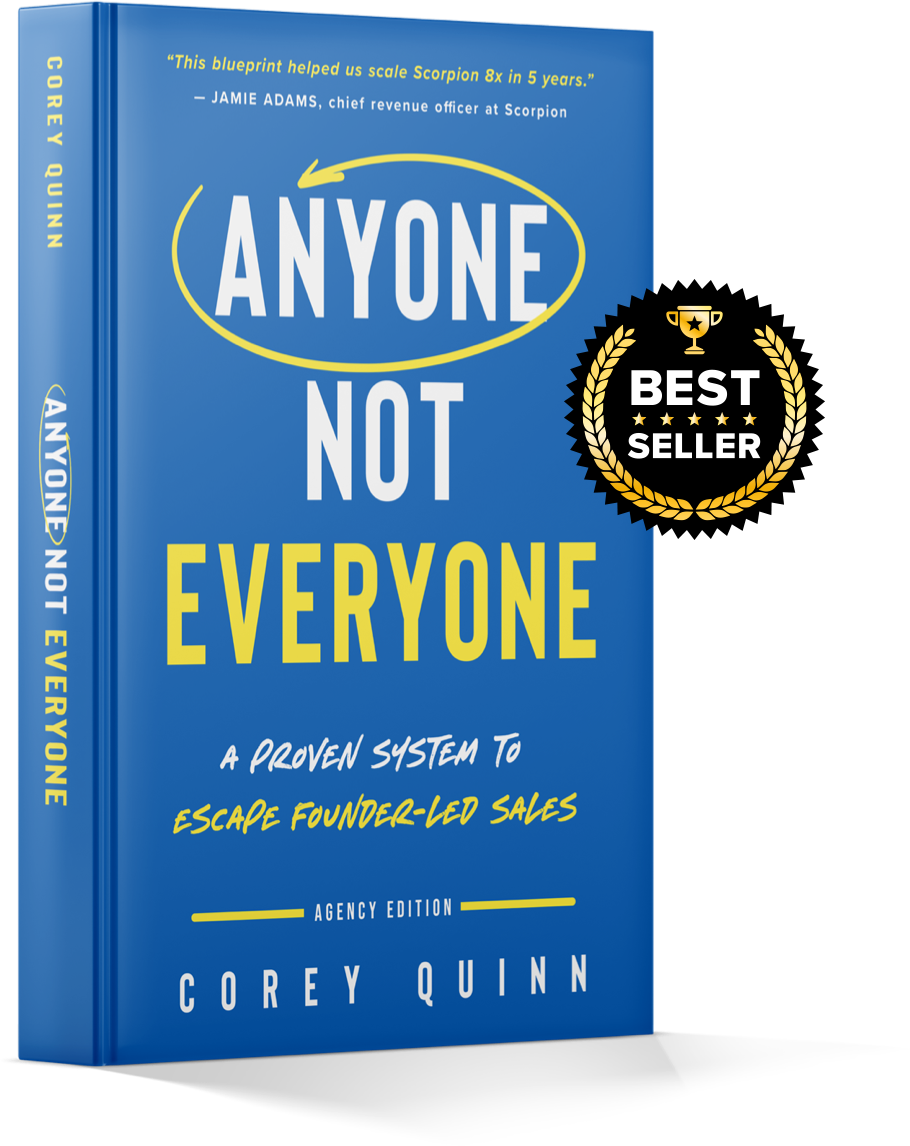
Corey helps founder-led agencies scale through Deep Specialization™ and programmatic M&A. Former CMO of Scorpion ($20M to $200M). Author of "Anyone, Not Everyone."