The Hidden Cost of Saying Yes to Everyone
Corey Quinn
Founder, Deep Specialization™
Saying yes to every client feels safe, but it creates hidden costs in sales, delivery, margins, positioning, and founder dependence. Here's what to do instead.
Early in an agency's life, saying yes makes sense. You need revenue. You need experience. You need proof. So when a prospect shows up with a budget, you take the meeting.
Can you build a website for them? Yes. Run paid media? Yes. Work in their industry? Sure.
Eventually, that flexibility starts looking like a strategy. It isn't.
For a mature agency, constantly saying yes quietly creates the very problems keeping the business from scaling: weak positioning, custom delivery, pricing pressure, founder-led sales, unpredictable pipeline, and a team stretched across too many kinds of work.
The danger is that none of these costs show up on an invoice labeled "lack of focus." They show up everywhere else.
When an agency tries to serve everyone and offer everything, the market struggles to understand why it's different. That pushes the agency toward competing on responsiveness, relationships, and price instead of expertise and outcomes.
That's the hidden cost of saying yes.
Saying Yes Feels Like Growth
This is what makes the problem hard to see. A new client adds revenue. Revenue is good. So another client must be good too.
But revenue isn't the only thing you're adding. Every out-of-fit client also adds new processes, new industry knowledge, new reporting requirements, new technology, new expectations, new exceptions, and new management overhead. Revenue goes up. Complexity goes up with it.
If complexity grows faster than your systems, the agency gets busier without getting stronger. That's why a bigger agency isn't necessarily a healthier one.
Cost #1: Your Positioning Gets Weaker
Try writing a homepage for an agency serving law firms, manufacturers, dentists, SaaS companies, restaurants, home services, and financial services. What message works for all of them?
Usually something vague. "We help ambitious companies grow." "We're a results-driven digital partner." "We create meaningful customer experiences." Technically true. Strategically useless.
The more people your message needs to accommodate, the less specifically it can speak to anyone. And when your positioning sounds generic, your buyer has less reason to believe you're uniquely qualified.
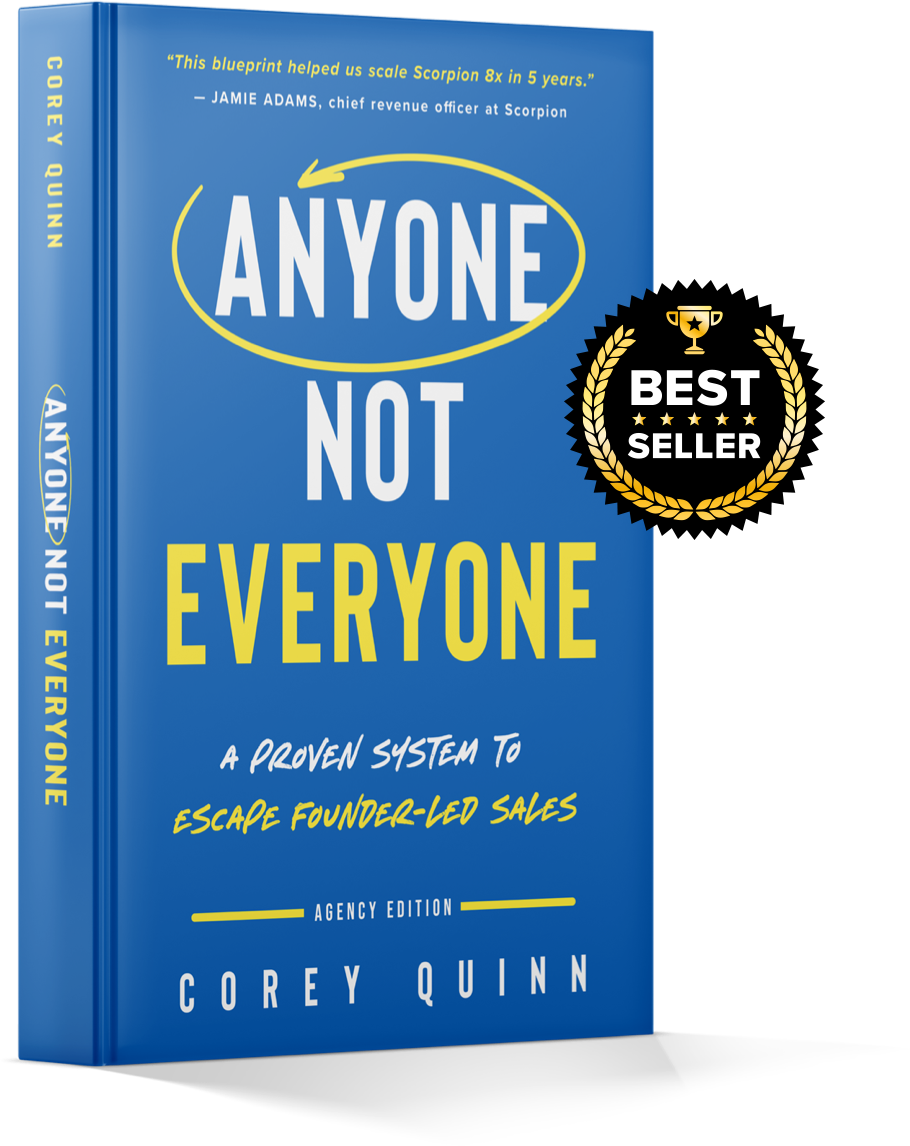
This is one of the central ideas behind Anyone, Not Everyone: tightly defining the target market lets you build more relevant positioning instead of competing in a market that's fundamentally too broad.
Cost #2: Your Sales Team Has to Work Harder
Weak positioning doesn't eliminate the need for differentiation. It just moves that work into the sales call.
Now the salesperson has to explain why your agency is different, why you're credible in this buyer's industry, why your process applies to them, why your past work is relevant, and why you're worth more than the generalist down the street. Every time.
A focused agency has a head start. Its positioning, case studies, language, and reputation already establish context. Specialization feels like subtraction at first but creates leverage later: narrow who you serve so the market immediately understands why to hire you, and you get stronger lead quality, easier sales conversations, greater pricing confidence, more efficient delivery, and sharper referrals.
Cost #3: The Founder Becomes the Universal Translator
Broad agencies create a strange dependency. The founder becomes the only person who can connect all the dots.
Why? Because the founder remembers the healthcare project from three years ago, the SaaS case study, the odd pricing exception, the relationship that led to the manufacturing account, the story behind every offer, and the nuance of ten different industries. A salesperson can't easily replicate that. So the founder gets pulled back into sales, again and again.
This is a structural growth constraint: when every meaningful sales opportunity runs through the founder, capacity is capped by one person's time and energy. Saying yes to everyone can look like customer orientation. In practice, it creates founder dependence.
Cost #4: Every Client Becomes a Custom Business
Here's another hidden tax. You close a client in a new industry. Now delivery has to learn that industry. The strategist researches it. The account team adapts. The reporting changes. The creative team learns a new buyer. The scope gets tweaked. Because the client is different from everyone else, the process bends.
Do that enough times and you don't have one agency. You have twenty miniature agencies sharing payroll.
When every client gets a different process, scope, and team, delivery becomes difficult to manage and even harder to scale. You're effectively running a new company on every engagement. Customization isn't inherently wrong. Endless customization is.
Cost #5: Your Margins Get Harder to Protect
Custom work is expensive, not just because it takes more hours, but because it's harder to estimate. You don't know exactly what the project will require, your team lacks repetition, and the scope has more unknowns. So projects drift. Hours expand. Margins shrink.
Then another problem shows up. Because your positioning is broad, the prospect may already see you as interchangeable with several competitors. Now you're dealing with higher delivery costs and greater price sensitivity at the same time. That's not a great combination.
Revenue growth can mask weak margins, poor utilization, and underpriced work, letting an agency get larger without necessarily getting healthier.
Cost #6: Your Marketing Never Compounds
Every agency publishes content. Far fewer build authority. The difference is focus.
If your agency serves everyone, your marketing jumps between unrelated subjects: lead generation for attorneys, SEO for plumbers, branding for SaaS, paid media for dentists, website strategy for manufacturers. You keep producing, but each piece speaks to a different audience. There's almost no accumulation.
Specialists get the opposite effect. One article reinforces the next. One case study makes the next sales call easier. One conference appearance builds credibility for the next. One client referral reaches another buyer in the same ecosystem. That's what compounding looks like.
Cost #7: Your Referrals Stay Generic
Think about how clients refer you. A generalist referral sounds like "I know a good agency." A specialist referral sounds like "you need to talk to them, they work with companies exactly like yours."
The specialist referral carries more weight. Specificity makes you easier to remember and easier to describe. That's why focus connects directly to sharper referrals and stronger market relevance.
Cost #8: You Train Your Team to Switch Context Instead of Build Expertise
There are two ways an agency team gets better. One is learning something completely new on every account. The other is going deeper into a set of recurring problems. The first creates breadth. The second creates expertise.
A team serving one focused market starts recognizing patterns. They know which strategies tend to fail, what benchmarks matter, and the industry language. They anticipate objections, know the technologies, and understand the buying cycle. Eventually they're not just executing marketing. They're advising the client. That's a much more valuable position.
Cost #9: You Become Easier to Compare
If your agency does everything for everyone, buyers need some way to distinguish you. They fall back on the most visible variables: price, portfolio, personality, speed, general capability.
That's dangerous, because most of those are easy for competitors to match. Deep Specialization™ changes the comparison. Instead of "which agency can run paid media?" it becomes "which agency understands paid acquisition for businesses like ours?" That's a fundamentally stronger competitive position.
Generalist agencies spread themselves thin, blend into a crowded market, and end up relying more heavily on discounting. Specialization creates more tailored solutions and a stronger competitive advantage.
Cost #10: You Spend Your Best Resources on the Wrong Clients
Your agency has finite capacity, finite leadership attention, finite creative energy, finite sales time, finite senior talent. Every time you say yes to a poor-fit account, you're pulling some of those resources away from the clients and markets where you could become exceptional.
That's opportunity cost, and it's one of the hardest costs to see. The question isn't "can we make money from this client?" The better question is "does this client help us build the agency we're trying to become?" Those answers aren't always the same.
Saying No Is a Strategy
This is where specialization gets uncomfortable. You have to reject some opportunities.
In Anyone, Not Everyone, I describe a specialist agency turning away an out-of-fit prospect even though the prospect had budget, referring them elsewhere instead. The result was increased respect for the agency's focus.
That's the part many founders want to skip. They want the advantages of specialization without the discipline. But a position becomes credible partly through what you choose not to do. If you say you're the specialist for one market but accept everything behind the scenes, eventually the operating model starts pulling your positioning apart.
But Doesn't Saying No Reduce Revenue?
In the short term, possibly. That's why this is hard. But the purpose isn't to maximize this month's revenue. It's to improve the economics of the business over time.
You may trade one random $20,000 project for more relevant case studies, higher close rates, better referrals, more efficient delivery, stronger margins, greater pricing confidence, a sales process that doesn't require the founder, and a more transferable agency.
The decision isn't revenue or no revenue. It's what kind of revenue you're building the company around.
Good Revenue and Bad Revenue
Not all revenue contributes equally to agency value.
Consider two $100,000 accounts. Client A requires constant founder attention, needs unusual services, has low margins, doesn't fit your positioning, can't be used as relevant proof, and is unlikely to refer your ideal buyers. Client B fits your vertical, uses your repeatable process, produces strong margin, creates a relevant case study, introduces you to peers, and deepens your team's expertise.
Both generate $100,000. They are not equally valuable. One increases complexity. The other increases leverage.
Revenue Can Hide the Problem
This is why saying yes becomes dangerous. Your P&L initially rewards the behavior. More accounts mean more top-line revenue. So you keep going.
Then one day you realize the team is exhausted, margins haven't improved, you need more managers, the founder is still in sales, marketing doesn't work predictably, and nobody knows which clients you really want.
You built more revenue. Not necessarily more enterprise value.
There's a real difference between getting busier and becoming more valuable. Margins, recurring revenue, retention, leadership depth, sales conversion, client concentration, and founder dependence are the indicators that actually tell you whether an agency is becoming a stronger asset.
What Should You Say Yes To?
Deep Specialization™ doesn't mean automatically rejecting every opportunity outside one narrow definition. It means developing criteria.
Before taking on an opportunity, ask: does this client fit the market we want to own? Do we deeply understand the problem? Can we apply an existing method? Does the work reinforce our positioning? Can this become relevant proof? Is the client financially attractive? Can our team deliver without creating major exceptions? Would we want ten more clients exactly like this?
That last question matters most. Would you want ten more? If the answer is no, think carefully about saying yes to one.
Focus Is Not a Constraint. It's an Allocation Decision.
Agency owners hear specialization and think restriction. That's not really what it is. It's allocation.
You're deciding where to put your expertise, your reputation, your sales resources, your marketing, your senior people, your intellectual property, your relationships, your time. Specialization is concentrating on the critical few instead of the trivial many, with focus as the route toward stronger growth and less founder dependence.
You're going to allocate those resources somewhere. The question is whether it's deliberate.
The Better Question
Stop asking "can we serve this client?" Most good agencies can serve a lot of clients.
Ask "should we?" Can they strengthen the market position you want? Can they deepen your expertise? Can they improve your economics? Can they create leverage? Can they move the agency toward a business that grows without depending on you?
If the answer is no, the revenue may be more expensive than it looks.
That's the hidden cost of saying yes to everyone. And that's why Anyone, Not Everyone isn't really about reducing opportunity. It's about choosing which opportunities deserve your agency's attention.
What's Next?
Once you stop trying to be the right agency for everyone, something important changes. You're no longer competing as a commodity. You can start building a position the market recognizes and values.
Next read: From Commodity to Category Leader
Related: Signs Your Agency Is Too Broad
Related: Why Niching Down Gets You More Clients
Related: Positioning That Makes Selling Easier
Frequently Asked Questions
Why is saying yes to every agency client a problem? Taking every available opportunity can weaken positioning, increase custom delivery, create margin pressure, dilute team expertise, and increase dependence on the founder. These problems are interconnected structural constraints on agency growth.
Should agencies turn down clients? Sometimes. Agencies should evaluate whether a prospect fits the market they want to own, their expertise, economics, delivery model, and long-term positioning. Anyone, Not Everyone specifically advocates selectivity as part of building a differentiated specialist agency.
Does saying no mean losing growth? Not necessarily. Declining poor-fit work creates room for more repeatable, profitable, strategically relevant work. The goal isn't maximum client count. It's building a stronger, more scalable agency.
How does a broad client base hurt profitability? Unrelated clients often require different scopes, processes, industry knowledge, and team configurations. That increases delivery complexity, makes work harder to estimate, and contributes to weaker utilization or margins.
How does specialization reduce founder-led sales? A focused agency can codify knowledge about a narrower buyer, problem, and solution. That makes expertise easier to transfer to salespeople and reduces reliance on the founder to personally explain why the agency is credible.
What is the difference between being selective and being too narrow? Being selective means choosing clients and markets where the agency can create a genuine advantage and healthy economics. Being too narrow means selecting a market that can't support the agency's goals. Deep Specialization™ requires both focus and market validation.
➡️ Discover Deep Specialization™
➡️ Book a Strategy Call
About Corey Quinn
Founder, Deep Specialization™
Corey helps founder-led agencies scale through Deep Specialization™ and programmatic M&A. Former CMO of Scorpion ($20M to $200M). Author of "Anyone, Not Everyone."