Founder-Led Sales Is Costing You Growth
Corey Quinn
Founder, Deep Specialization™
Founder-led sales can help an agency grow early, but it eventually becomes a bottleneck. Learn how to build a repeatable sales system that does not depend on you.
You are the best salesperson in your agency.
You understand the work better than anyone.
You know how to read a prospect.
You can diagnose the real problem behind the problem.
You know which proof points matter. You know which objections are real. You know when to push.
That is why founder-led sales works in the beginning.
It is also why it stops working.
When every deal depends on you, your sales capacity is your calendar.
You have not built a sales system.
You have become the sales system.
That gets you to your first stage of growth.
It will not get you to the next one.
Founder-Led Sales Works Until It Becomes the Ceiling
Most agencies start with founder-led sales because there is no one else to do it.
The founder builds the relationships.
The founder earns the referrals.
The founder leads discovery calls.
The founder writes the proposals.
The founder closes the work.
Early on, this is not a weakness. It is an advantage.
Prospects get direct access to the person with the most authority and conviction. You make decisions fast. You adapt the conversation on the call.
The model gets harder to sustain as the agency grows.
More opportunities require more calls.
More calls require more follow-up.
More proposals require more customization.
More clients require more oversight.
At some point, sales competes with leadership, operations, and client work for your attention.
That is when growth hits your calendar and stops.
The founder is not bad at sales. The agency has never captured what makes the founder effective and turned it into a repeatable process.
The Founder Is Often the Strongest Seller for Good Reasons
Founders sell well because they have advantages that are hard to replicate.
They have credibility.
They know how the agency creates value.
They understand the work behind the promise.
They talk about client problems without a script.
They know what the agency should and should not sell.
They spot a poor-fit client before the rest of the team sees the risk.
They care about the outcome because they own the business.
These strengths should not leave the sales process. They should be documented, strengthened, and transferred.
That is the shift.
You do not need to exit sales tomorrow. You need to stop making every sale depend on you.
The Signs That Founder-Led Sales Is Holding You Back
Founder dependency does not always look like a lack of process.
You may have a CRM.
You may run pipeline meetings.
You may have sales templates.
You may even have a salesperson.
The system is still founder-led if you are still required for deals to move.
Common signs:
Nearly every important prospect wants to speak with you.
You join most discovery or proposal calls.
Follow-up slows when you get busy.
Sales activity drops during heavy delivery periods.
Qualification standards shift from one deal to the next.
Proposals get rewritten for every prospect.
The team cannot explain why deals are won or lost.
Forecasting runs on instinct, not evidence.
Prospects hear a different message depending on who takes the call.
The salesperson creates activity but struggles to create trust.
You step in late to rescue deals.
The agency keeps hiring salespeople without fixing the process.
None of these is an execution problem. The sales knowledge still lives inside one person.
Why Hiring a Salesperson Usually Does Not Fix It
When sales overwhelms the founder, the obvious move is to hire someone.
Sometimes it works. Most of the time it does not.
The new salesperson joins and gets a loose set of instructions.
"Go find more clients."
"Use the deck."
"Follow up with these leads."
"Sit in on my calls."
"Learn how I sell."
You expect the salesperson to reproduce years of experience and judgment without a system to run.
When they struggle, you decide the hire was wrong.
Sometimes it was. More often, you asked a person to succeed inside a process that did not exist.
A salesperson cannot scale:
Unclear positioning
A vague ideal client profile
Inconsistent qualification
Custom proposals
Weak proof
Undefined sales stages
Irregular follow-up
Founder-dependent credibility
Hiring before you document the system does not remove the bottleneck. It hands your confusion to someone else.
Founder-Led Sales Is Often a Positioning Problem
Most sales problems start before the sales conversation does.
Broad positioning makes your salesperson work harder to explain why you are relevant.
If you serve many unrelated industries and change your message for each one, every conversation starts from zero.
The seller builds credibility again and again.
The prospect works harder to see the fit.
The proposal gets more custom.
The sales cycle gets less predictable.
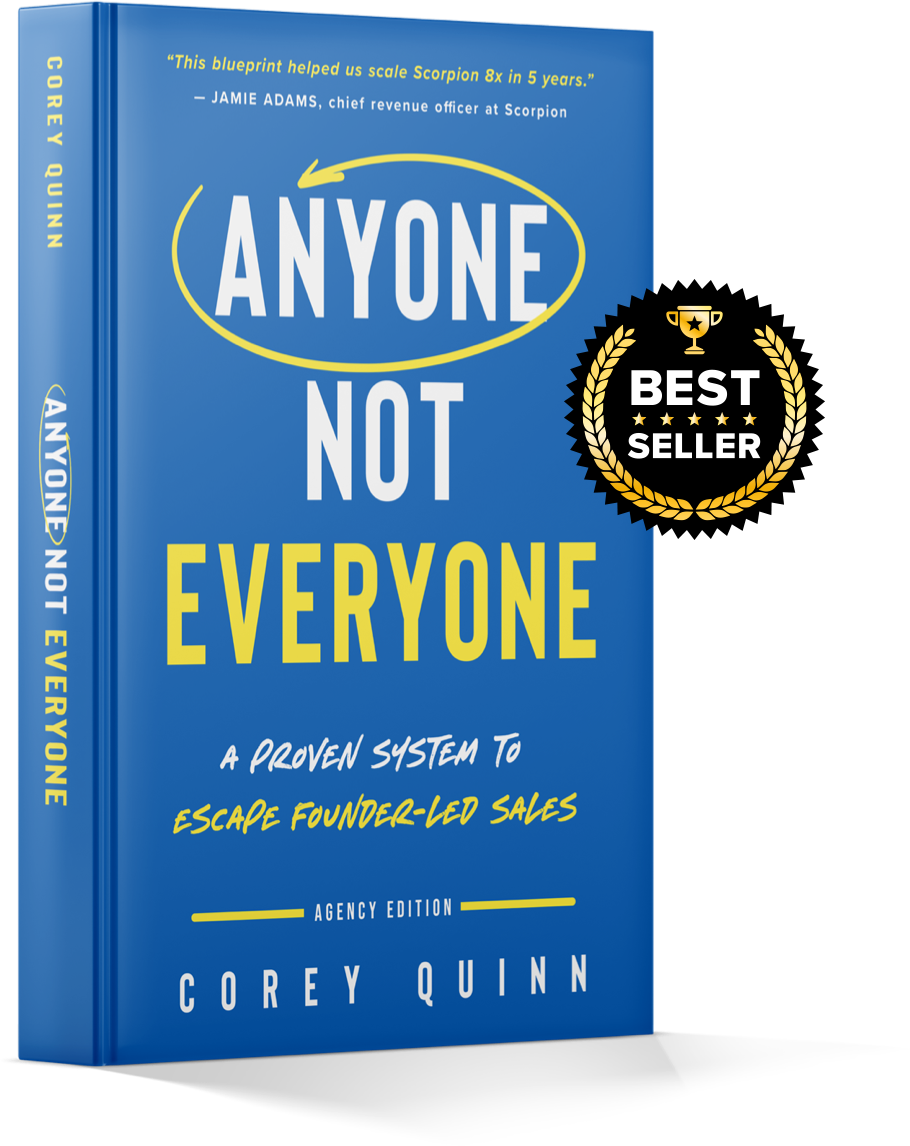
This is one of the central arguments in my book, Anyone, Not Everyone.
Agencies do not need to be attractive to the whole market. They need to be the obvious choice for one.
Deep Specialization™ takes weight off the sales process. It creates alignment around who you serve, which problem you solve, what you deliver, and what outcome the client values.
When that is clear, prospects need less education. Your proof lands harder. You speak the buyer's language. The client sees less risk in saying yes.
Specialization does not remove the need for skilled salespeople. It hands them a stronger position to sell from.
I define Deep Specialization as disciplined focus on one vertical market. Done right, it makes you the most relevant and trusted choice for those buyers.
The Real Cost of Founder-Led Sales
The cost is not just your time. Founder-led sales affects the whole business.
It limits sales capacity
There are only so many conversations you can lead. When demand rises, you cannot respond fast, follow up consistently, and move every deal forward on your own.
It creates an unpredictable pipeline
When you are buried in delivery or client issues, business development slows. You sell in bursts. Then the pipeline goes quiet. The agency sells when you have time, not on a reliable rhythm.
It weakens forecasting
You may have strong instincts about deals. Instincts are hard to measure and harder to transfer. Without consistent qualification, defined stages, and clear next steps, the pipeline is a pile of conversations, not a forecast.
It makes sales hiring harder
A new hire is expected to reproduce your results without your experience, authority, or relationships. The agency blames the hire instead of the system.
It increases founder dependency
A business that runs on you is hard to step away from. It is harder to sell. A buyer is not paying for your calendar. A buyer pays for a system that creates and converts demand without you. Real wealth for an agency owner comes from equity and a clean exit. Founder-led sales puts a ceiling on both.
It keeps you in the wrong role
You spend your time answering routine questions, joining calls, and reviewing proposals. That is time you are not spending on strategy, partnerships, and building enterprise value. Founder-led sales does more than slow growth. It delays your move into the role the business needs next.
What a Repeatable Agency Sales System Looks Like
A repeatable system does not make every conversation sound identical. It creates enough structure to handle opportunities consistently without removing judgment.
The system should make clear:
Who the agency is built to serve
Which prospects to disqualify
How opportunities enter the pipeline
What happens at each stage
Which questions to ask
What evidence to share
Who owns each next step
When and how follow-up happens
How proposals get built
How the team forecasts revenue
When you should get involved
A strong system captures your best thinking without requiring you to execute every step.
I call my version of this the Trusted Advisor Sales System, or TASS. Your buyer does not want to be pitched. They want an advisor who diagnoses the real problem before prescribing a fix. A doctor does not write a prescription in the waiting room. Neither should your salesperson.
A TASS sales conversation has three parts. Each one replaces something you do on instinct with something a trained salesperson can repeat.
The first part earns trust fast. I use a short, ordered set of six slides I call the 6-Slide Trust Multiplier. The six slides establish who you serve, the problem you solve, and the proof that you are the right agency. It front-loads the credibility you carry into the room, so a salesperson can carry it too.
The second part is discovery, run through the DOCTOR framework. DOCTOR stands for Diagnosis, Outcome, Challenges, Toll, Ownership, and Readiness. You diagnose the real problem. You define the outcome the client wants. You surface the challenges in the way. You name the toll of leaving the problem unsolved. You confirm who owns the decision. You test how ready they are to act. It turns your gut read of a prospect into a set of questions anyone on the team can ask.
The third part is the close, and it is simpler than most founders make it. I call it BAMFAM: Book A Meeting From A Meeting. You never end a call without the next meeting on the calendar. That one habit prevents most stalled deals.
The seven steps below build the system around that conversation.
Step 1: Define the Ideal Client Clearly
A sales system cannot be repeatable if you sell to anyone who takes a call.
The first requirement is a clear ideal client profile. This goes past industry, company size, and revenue.
A useful profile helps the team see:
Which clients you serve best
Which problems you are built to solve
Which buying conditions signal urgency
Which clients value the work
Which clients stay
Which clients create operational risk
Which opportunities to reject
The clearer you define the right client, the easier it is to qualify deals consistently.
This is why Deep Specialization matters. When you focus on one vertical, the team starts to recognize patterns: how those buyers think, what they fear, what language they use, how they decide. That knowledge sharpens marketing and sales.
Step 2: Document the Founder's Sales Process
Most founders have a process. It is just undocumented.
You know which questions to ask.
You know how to frame the problem.
You know which client story to share.
You know when a prospect is serious.
You know which objections signal risk.
That knowledge shows up as instinct. The first job is to make it visible.
Review recent calls and document:
How the conversation opens
Which discovery questions get asked
How you diagnose the problem
How you introduce the agency's point of view
Which proof points build trust
How you explain the offer
How you handle objections
How you confirm next steps
How you manage follow-up
Do not start with the perfect methodology. Start with what already works. Then shape it toward the TASS structure: open with the Trust Multiplier, run discovery with DOCTOR, close with BAMFAM. Your documented instincts are the raw material. The framework gives them a repeatable shape.
Step 3: Build Clear Qualification Standards
Not every opportunity deserves the same time. A repeatable system needs qualification standards so the team can tell apart:
A strong-fit buyer
An early-stage conversation
A low-priority prospect
A poor-fit client
A deal to disqualify
Qualification can include:
Fit with your specialization
Severity of the problem
Urgency
Budget
Decision authority
Internal alignment
Past attempts to solve the problem
Willingness to follow your process
Potential client value
Delivery risk
Qualification protects your time and improves the quality of your pipeline.
Step 4: Define Real Sales Stages
Many agency pipelines track seller activity, not buyer progress.
For example:
Contacted
Followed up
Proposal sent
Those stages show what the agency did. They do not show whether the buyer is moving toward a decision.
A stronger pipeline reflects real progress:
Fit confirmed
Problem acknowledged
Decision process understood
Solution aligned
Commercial terms reviewed
Verbal commitment received
Agreement signed
Each stage needs a clear entry condition, exit condition, owner, and next action. That makes forecasting more reliable and pipeline reviews more useful.
Step 5: Create a Consistent Follow-Up Process
Most agency deals do not die on a no. They die when follow-up stops.
The best follow-up starts on the call, not after it. This is the discipline behind BAMFAM: book the next meeting before the current one ends. There is always a scheduled next step, so follow-up supports a commitment the prospect already made.
Founder-led follow-up runs on memory, spare time, and motivation.
A repeatable system defines:
Who follows up
When follow-up happens
What message goes out
Which value gets added
When to pause the opportunity
When to disqualify it
When to reactivate it
Follow-up should not feel like asking for an update again. Each touch should help the prospect decide. That might be:
A relevant case study
A useful insight
A summary of the problem
A clarification of next steps
A client example
A resource tied to the buyer's concern
A direct question about what is blocking progress
Consistency matters more than intensity.
Step 6: Standardize the Proposal Process
If every proposal is built from scratch, you have not fully defined your offer.
A strong proposal process reinforces what discovery already surfaced. It should explain:
The client's situation
The problem being solved
The proposed approach
The scope
The expected outcome
Responsibilities
Timeline
Investment
Next steps
A proposal should confirm the solution, not introduce a new one. It confirms alignment around something the prospect already understands.
Standardizing the proposal also cuts founder involvement. The team stops waiting for you to rewrite the agency's value for every deal.
Step 7: Transfer Sales Responsibility Gradually
You should not disappear from sales overnight. That creates unnecessary risk. Move responsibility in stages.
A salesperson or sales leader might start by:
Observing founder-led calls
Leading parts of discovery
Owning follow-up
Running qualification calls
Leading full sales conversations
Managing proposals
Closing defined types of deals
Owning forecasting and pipeline
You might stay involved in:
Strategic accounts
Complex opportunities
High-value relationships
Executive conversations
New offers
Important partnerships
Now your involvement is a choice, not a default.
When Should the Founder Still Be Involved?
Removing founder dependency does not mean removing founder value. There are moments where your involvement strengthens the sale.
Those include:
A highly strategic prospect
A large or unusual opportunity
A new market
A complex buying committee
A senior executive conversation
A partnership opportunity
An offer you have not fully proven yet
The question is whether the deal can progress without you in every stage. A healthy system uses your credibility at the right moments. It does not eat your calendar by default.
The Sales Metrics That Matter
A repeatable system should be measurable. Useful agency sales metrics:
Qualified opportunities created
Pipeline coverage
Conversion rate by stage
Average deal value
Average sales cycle
Win rate
Loss reasons
Follow-up activity
Source of opportunity
Proposal-to-close rate
Forecast accuracy
Founder involvement per deal
Track founder involvement closely. If every closed deal still needs you, you have not built an independent sales capability yet.
What Changes When Sales Stops Depending on You
When the system gets stronger, the wins go past revenue.
The pipeline gets easier to read.
Follow-up gets consistent.
Sales hiring gets more effective.
Prospects hear a clearer message.
Poor-fit clients get caught earlier.
Forecasting improves.
You get your time back.
The agency gets less fragile.
The business gets more valuable, because revenue no longer depends on one person. That is what a buyer pays for.
That is the larger goal of founder-led agency growth. Your knowledge becomes an asset the business owns, not a dependency it cannot run without.
Frequently Asked Questions
What is founder-led sales?
Founder-led sales is a model where the agency owner personally generates, manages, and closes most new business. It works in the early stages of growth. It becomes a constraint when sales cannot move without the founder.
Why is founder-led sales a problem?
It becomes a problem when sales capacity is capped by the founder's time, availability, and personal credibility. It creates an unpredictable pipeline and makes growth hard to scale.
Should the founder stop selling completely?
No. The founder can stay involved in strategic opportunities, executive conversations, and key relationships. The goal is to make that involvement intentional, not required for every sale.
When should an agency hire its first salesperson?
After it has clarified positioning, ideal client profile, offer, qualification standards, sales stages, follow-up, and proof. Hiring before these are clear hands an inconsistent process to the new rep.
Why do agency sales hires fail?
They fail when the rep is asked to reproduce the founder's knowledge and credibility without a documented system, clear positioning, relevant proof, or a steady source of qualified opportunities.
How does specialization improve agency sales?
Specialization makes the agency more relevant to a defined market. The team learns the buyer's language, problems, and decision process, so the team can build trust and show expertise faster.
What should be included in an agency sales playbook?
The ideal client profile, qualification standards, discovery questions (I structure mine with the DOCTOR framework), sales stages, objection handling, proof points, proposal process, follow-up expectations, forecasting rules, and ownership.
How long does it take to move beyond founder-led sales?
It depends on your positioning, team, offer, and current process. The transition should happen gradually: document your approach, add structure, develop the team, and transfer responsibility in stages.
Build a Sales System, Not Another Dependency
Founder-led sales is normal. It is how most agencies start.
The model gets expensive when every deal still depends on you years later.
You should not have to choose between selling and leading.
You should not have to pause business development when client work gets busy.
You should not have to rescue every proposal or close every deal.
You do not need to remove yourself from sales immediately. Capture what works. Turn it into a system. Build the team to run it.
That is how sales stops being a personality.
It becomes a capability.
And that is how your agency grows past the limits of your calendar.
Build an Agency That Can Grow Without You
A repeatable sales system gives you a reliable way to generate, qualify, follow up on, and convert opportunities without managing every step. It gives you back the time to do the work only you can do.
Get Your Agency Growth Score
Identify the biggest constraint keeping your agency from its next stage of growth.
Explore Founder-Led Agency Growth
Read the complete guide to building an agency that grows without depending on you.
About Corey Quinn
Founder, Deep Specialization™
Corey helps founder-led agencies scale through Deep Specialization™ and programmatic M&A. Former CMO of Scorpion ($20M to $200M). Author of "Anyone, Not Everyone."