Why Most Agencies Plateau at $1M–$5M
Corey Quinn
Founder, Deep Specialization™
Most founder-led agencies stall between $1M and $5M because growth still runs through the founder. Here is what causes the ceiling and how to break it.
Your agency is not stuck because you ran out of opportunities.
It is stuck because you became too important.
That is the core tension in founder-led agency growth.
Your judgment, relationships, and credibility built the agency’s early success. Those same strengths become the ceiling. Every important decision, sales conversation, and client relationship still runs through you.
So the agency reaches somewhere between $1 million and $5 million in revenue. Then it hits an invisible ceiling.
Revenue still climbs. The team still grows. From the outside, the agency looks successful.
Inside, you are busier and more essential than ever.
That is not sustainable growth. It is founder dependency disguised as momentum.
The Plateau Is Not Really About Revenue
There is nothing magical about the $1 million or $5 million mark.
Some agencies hit these problems earlier. Others grow past them before the cracks show.
The revenue number is a symptom. The real cause is that the agency has outgrown the informal way it runs.
Early on, you hold the business together yourself.
You know every client. You review the important work. You step into the hard conversations. You decide fast, because most of the agency’s commercial knowledge lives in your head.
That works while the agency is small.
As it grows, the clients, projects, proposals, and decisions multiply. Your capacity does not.
You reach the point where more activity stops creating leverage. It just creates pressure.
A Familiar Founder Conversation
Here is what I hear from agency owners constantly:
We are busier than ever. Revenue is up. We have hired more people. But somehow, I have less time than I did two years ago.
That is not bad luck. It is what happens when the business grows, but the way it operates does not.
You may have handed off parts of delivery. You still own:
New business
Key sales calls
Pricing decisions
Top client relationships
Team escalations
Hiring approvals
Strategic direction
Quality control
Financial decisions
You have more people. You do not have more independence.
You delegated the work without transferring the authority to own it.
Why Most Agencies Plateau
The plateau is rarely one problem. It is several weaknesses feeding each other.
Broad positioning makes sales harder.
Inconsistent sales create revenue pressure.
Revenue pressure pushes you to accept poor-fit clients.
Poor-fit clients create customized delivery.
Customized delivery weakens margins.
Weak margins make it harder to invest in leadership.
Without leaders, everything routes back to you.
The result is a business that keeps moving but never gets more valuable.
Here are the most common reasons it happens.
1. You Are Still Trying to Serve Anyone
You reached the first stage of growth by being flexible. You took different industries. You offered a wide range of services. You shaped the offer around whatever the prospect asked for.
That flexibility helped you survive. Eventually it becomes the constraint.
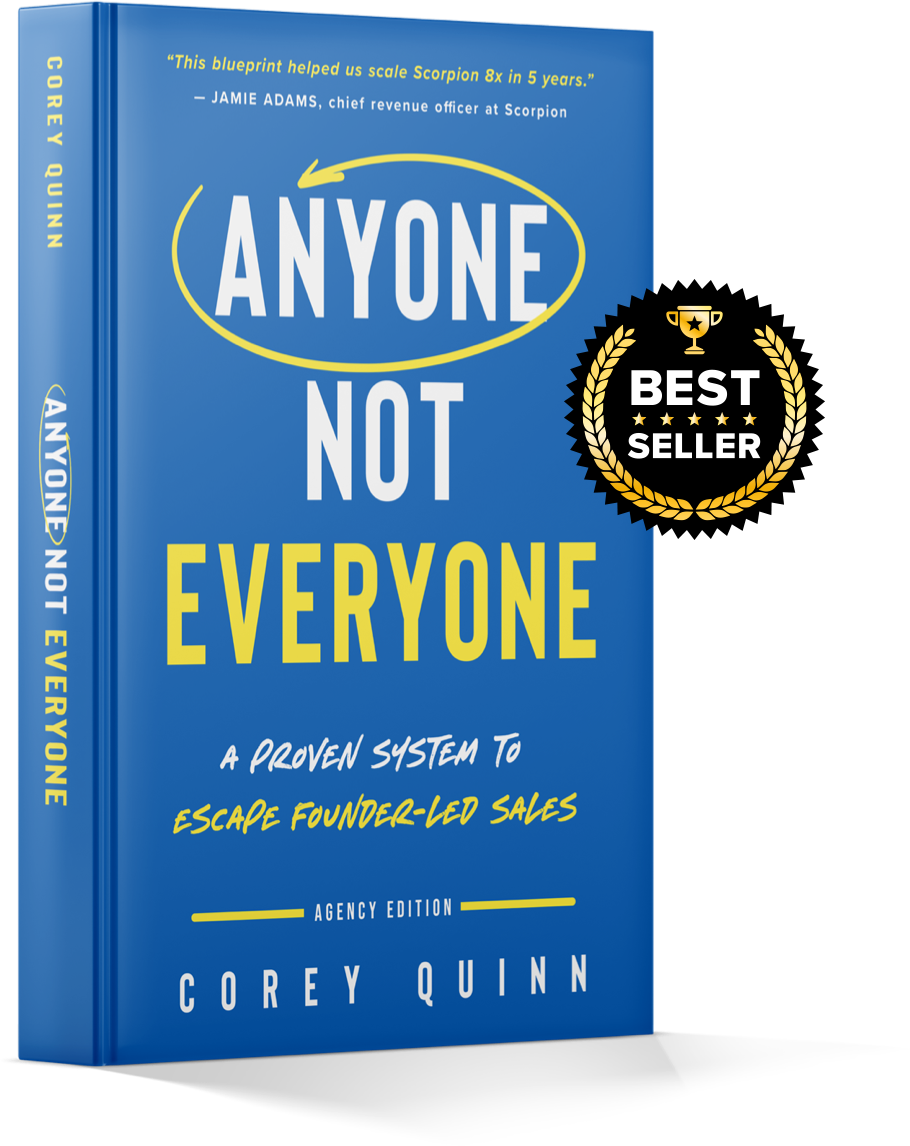
I wrote a whole book about this. The argument of Anyone, Not Everyone is simple. Agencies do not grow by appealing to the entire market. They grow by becoming the obvious choice for one market.
You do not need everyone to choose you. You need the right clients to see why you are the obvious choice.
When you try to serve anyone, the problems stack up. Your messaging goes broad. Your services resist standardizing. Your sales process needs more explaining. Your proof feels less relevant. Your referrals get vaguer.
You can be capable of many things. Capability alone does not create a market position.
A prospect needs to understand:
Who you serve best
The high-value problem you solve
Why your experience is relevant
How your approach is different
The outcome you can create
This is where Anyone, Not Everyone connects to Deep Specialization™.
Deep Specialization™ is more than picking an industry niche. It aligns the agency around:
A clearly defined ideal client
A specific and valuable problem
A repeatable offer
A differentiated method
A meaningful client outcome
Specialization does not make you smaller. It makes you more relevant.
That relevance improves lead quality, pricing power, referrals, sales efficiency, delivery consistency, and enterprise value.
2. You Have Become the Sales System
You are usually the agency’s best salesperson. That makes sense.
You understand the work. You have credibility. You know the client’s problems. You can answer the hard questions. You spot a real opportunity fast.
Founder-led sales is an advantage early on.
The problem starts when the whole process depends on your presence, your memory, and your relationships.
At that point, you are not involved in sales. You are the sales system.
You can usually see this in a few predictable ways:
You join nearly every important sales call.
Follow-up depends on personal memory.
Qualification criteria are unclear.
Proposals get reinvented for each prospect.
Pipeline stages do not reflect real buying progress.
The team cannot explain why deals are won or lost.
Sales slows whenever you get busy with delivery.
Prospects expect direct access to you before they decide.
Hiring a salesperson does not fix this. Hire too early and you just hand the confusion to someone new.
The first step is to document what already works:
Ideal client criteria
Qualification standards
Discovery questions
Sales stages
Follow-up expectations
Common objections
Proof and case studies
Proposal standards
Handoff responsibilities
Forecasting rules
The goal is not to pull you out of sales overnight. It is to turn your judgment into a system the agency can run, measure, and eventually own without you.
3. Referrals Are Doing Too Much of the Work
Referrals are valuable. They bring warm introductions and strong-fit clients.
But referrals are not a growth system. You cannot control them. You cannot forecast them. They rarely show up when you need them most.
A referral-dependent agency swings between two states. When delivery is busy, business development stops. When the work dries up, you scramble for pipeline. That is the feast-and-famine cycle, and it does not end on its own.
The answer is not to kill referrals. It is to back them with a deliberate demand engine.
That includes:
Authority-building content
Strategic partnerships
Focused networking
Referral development
Gift-Based Outbound™
Targeted prospecting
Speaking and podcast appearances
Consistent follow-up
A clearly defined prospect list
Consider two agencies.
Agency A gets nearly all of its business from referrals. Agency B gets opportunities from referrals, partnerships, outbound, content, and existing relationships.
Agency A has strong demand today. Agency B has a stronger system.
Predictable growth does not mean every month is identical. It means you have a repeatable way to create and convert opportunities instead of waiting for them to appear.
4. Every Client Engagement Is Reinvented
You may take pride in customized work. Adapting to a client is not the problem.
The problem shows up when every engagement has a different:
Scope
Process
Team structure
Pricing model
Timeline
Set of responsibilities
Definition of success
Customizing everything creates complexity. Delivery gets harder to manage. Scope creep multiplies. Margins get murky. Onboarding slows. And the work leans harder on your senior people.
It also caps your scale. The team keeps re-solving problems that should already have an answer.
Productizing your expertise does not mean flattening strategy into a generic package. It means building a repeatable method for a recurring problem.
A stronger offer usually includes:
A clearly defined client
A specific problem
A consistent methodology
Clear scope boundaries
Defined milestones
Shared responsibilities
A credible expected outcome
Pricing connected to value
Repeatability creates leverage. It also lets you improve the work, because you are no longer rebuilding every engagement from scratch.
5. You Delegate the Tasks but Keep the Decisions
You believe you delegated, because other people do the work now. But you still approve every important decision.
The team runs projects and clients. The questions still travel up to you.
You are still the default escalation point for:
Client issues
Pricing exceptions
Hiring decisions
Team conflicts
Scope changes
Quality concerns
Financial choices
Strategic priorities
That is delegated execution with centralized decisions, not real independence.
As the agency grows, your role has to change. Less time solving today’s problems. More time on:
Direction
Positioning
Leadership
High-value relationships
Strategic growth
Financial performance
Enterprise value
That takes more than hiring managers. It takes a real leadership system.
The agency needs:
Clear roles
Defined decision rights
Measurable expectations
Consistent meeting rhythms
Reliable financial information
Documented operating processes
Capacity planning
Client health monitoring
Clear escalation rules
You should still matter. The business should not wobble every time you step away.
6. Revenue Is Hiding the Real Problem
Revenue is easy to see. It is easy to celebrate. It also hides what is actually happening.
You can grow revenue while running:
Lower gross margins
Higher delivery costs
Weak cash flow
Poor utilization
Underpriced work
Client concentration
Excessive hiring
Founder burnout
Unpredictable sales
Declining profitability
Sometimes you get bigger without getting better. Every new client needs more people, more management, more of you. That is not leverage. It is complexity.
Here is the part most founders miss. Your wealth is not in this year’s revenue. It is in what the agency is worth when you sell it.
Buyers do not pay a premium for a busy founder. They pay for a business that runs without one.
So look past top-line growth. The indicators that matter:
Gross margin
Operating profit
Cash flow
Pipeline coverage
Win rate
Average deal value
Client retention
Revenue concentration
Team utilization
Predictable or recurring revenue
Leadership depth
Founder involvement
These numbers answer a more useful question. Is the agency just getting busier, or is it getting more valuable?
7. You Keep Adding Instead of Diagnosing
When growth slows, you add something.
A new salesperson. A new service. A new campaign. A new website. A new platform. More content. More events. More activity.
Some of those moves help. None of them break the plateau unless they hit the real constraint.
A lead-gen problem is often a positioning problem.
A sales problem is often a qualification problem.
A margin problem is often a customization problem.
A delivery problem is often a scoping problem.
A leadership problem is often a decision-rights problem.
A hiring problem is often an operating-model problem.
More activity is not more progress. Usually it just adds noise around the real issue.
Real growth starts with diagnosis. Find the one constraint creating the most friction across:
Demand
Sales
Delivery
Profitability
Leadership
Founder capacity
The most visible problem is rarely the root cause.
The Four Stages of Founder-Led Agency Growth
Founders get frustrated because they run a strategy built for one stage while they are actually in another.
Stage 1: Founder-Driven
You win most clients, lead delivery, and hold the key relationships. The job is to prove demand and build a reputation.
Primary challenge: You and the business are the same thing.
Stage 2: Team-Supported
You hire and start delegating delivery. Revenue grows, but you still control sales, strategy, and the big decisions.
Primary challenge: Work is delegated without systems or accountability.
Stage 3: System-Led
You build clearer positioning, repeatable offers, a structured sales process, and consistent delivery. Managers start taking real ownership.
Primary challenge: Replacing what lives in your head with documented capability.
Stage 4: Leadership-Led
The agency has capable leaders, predictable demand, real financial visibility, and low founder dependency. You focus on strategy, enterprise value, and the long game.
Primary challenge: Protecting focus while performance keeps improving.
The right move depends on your stage and your constraint. Not your next revenue target.
How Agencies Move Beyond the Plateau
Breaking the $1 million to $5 million plateau is not about adding complexity. It is about rebuilding the business around a few connected foundations.
Become more specific
Get clear on who you are built to serve, the problem you solve best, and the outcome you can repeat. The core lesson of Anyone, Not Everyone is that growth starts with a deliberate decision about who matters most.
Build a repeatable sales system
Document how opportunities are created, qualified, advanced, followed up, and converted.
Productize your expertise
Build a consistent method and client experience without removing the judgment that makes the work valuable.
Build leadership beyond the founder
Give capable people real accountability, authority, and performance expectations.
Improve financial visibility
Track the metrics that reveal sales health, profitability, capacity, and founder dependency.
Reduce founder involvement gradually
Do not rip yourself out of the business overnight. Transfer responsibilities, knowledge, and decisions deliberately.
These changes reinforce one another.
Better positioning makes selling easier.
A clearer offer makes delivery more repeatable.
Repeatable delivery improves margins.
Stronger margins create room to invest in leadership.
Better leadership reduces founder dependency.
That is how an agency becomes more scalable, more profitable, and worth more.
What Sustainable Growth Actually Looks Like
Sustainable growth shows up as clarity across the business.
Prospects understand who you serve and why your expertise matters.
The pipeline is fed by more than one source of demand.
Sales follows a defined process.
The offer is easier to understand and deliver.
Managers make decisions without escalating everything to you.
Revenue growth is backed by healthy margins.
You spend your time on the highest-value work instead of every client issue, proposal, and operational decision.
The agency does not get less dependent on you because you work harder. It gets less dependent because the business gets more capable.
Start With the Constraint
Most founders assume growth requires more.
More clients. More people. More services. More marketing.
The agencies that break through do the opposite.
They get more focused. More specialized. More systematic. More disciplined.
They stop trying to be everything to everyone. They stop leaning on the founder to hold it all together. They stop measuring success by revenue alone. They start building capability that outlives any one person.
This is the same argument I make in Anyone, Not Everyone. Growth begins when you decide who you are built to serve and become exceptionally valuable to that market.
The answer is clarity about what to change next. Not more activity.
Frequently Asked Questions
Why do agencies plateau at $1 million?
Agencies plateau near $1 million when the informal processes that drove early growth stop scaling. Sales, client relationships, delivery, and quality control still depend on the founder.
Why do some agencies plateau between $3 million and $5 million?
By this stage the team is bigger, but positioning, repeatable sales, consistent delivery, and leadership are still missing. Complexity grows faster than capability.
What is the biggest bottleneck in founder-led agency growth?
Founder dependency. When sales, client, delivery, and leadership decisions all run through one person, the agency’s capacity is capped by that person’s time and attention.
What does Anyone, Not Everyone mean for agency growth?
Anyone, Not Everyone is my argument that an agency should stop trying to appeal to the entire market. You identify the clients you are best positioned to serve, then align your expertise, offer, positioning, and sales system around their most important problems.
Should an agency hire a salesperson to break through the plateau?
Usually not first. Hire before you document positioning, qualification, discovery, and follow-up, and you hand an unclear process to someone new. Make the system repeatable, then transfer it.
How does specialization help an agency grow?
Specialization makes you easier to understand, trust, refer, and hire. It improves lead quality, pricing power, sales efficiency, delivery consistency, and enterprise value.
Can an agency grow without hiring a large team?
Yes. Growth comes from stronger positioning, better pricing, productized expertise, sharper systems, AI-driven efficiency, and a more focused client base. Headcount is not the measure of growth.
How can a founder reduce dependency without leaving the business?
Document your sales and delivery methods. Define decision rights. Develop leaders. Set performance rhythms. Transfer responsibilities gradually. The goal is organizational independence, not your absence.
Build an Agency That Grows Without Consuming You
Your agency should create opportunity, not permanent dependence.
With clearer positioning, a predictable sales system, repeatable delivery, stronger leadership, and financial discipline, the business grows without keeping you at the center of everything.
Build an agency that is easier to run, more profitable, and worth more when you decide to sell.
Get Your Agency Growth Score
Identify the biggest constraint keeping your agency from its next stage of growth.
Explore Founder-Led Agency Growth
Read the complete guide to building an agency that grows without depending on you.
About Corey Quinn
Founder, Deep Specialization™
Corey helps founder-led agencies scale through Deep Specialization™ and programmatic M&A. Former CMO of Scorpion ($20M to $200M). Author of "Anyone, Not Everyone."