How Founder Dependence Affects Agency Valuation
Corey Quinn
Founder, Deep Specialization™
A buyer isn't purchasing your calendar. An agency built around the founder can grow revenue for years and still be worth almost nothing, because the moment you leave, so does the reason clients stay.
A buyer isn't purchasing your calendar. An agency built around the founder can grow revenue for years and still be worth almost nothing, because the moment you leave, so does the reason clients stay.
How buyers price founder dependence
Diligence looks directly for key-person risk: who owns the top client relationships, who runs new business, who makes the final call on strategy and hiring. If the answer to all three is "the founder," a buyer has to assume some percentage of revenue walks in the twelve months after close. That assumption becomes a discount on the multiple, a structural earnout tied to retention, or both.
Most operational problems show up as a cost. Founder dependence shows up as a direct multiple discount, because it puts the thing the buyer is actually purchasing at risk: future cash flow they don't control.
Where founder dependence actually lives
It's rarely just one thing. It's usually spread across three places.
Sales. If you're the closer on every deal, revenue growth is capped at your calendar and disappears without you.
Key client relationships. If clients renew because they trust you personally rather than the team or the system, that trust doesn't transfer at close.
Strategic and operational decisions. If every meaningful call routes through you, there's no leadership layer a buyer can underwrite.
How to reduce it
Start with sales. Build a repeatable, documented sales process that a hired seller can run, one that depends on your specialization instead of your personal relationships or reputation. Then move client relationships to a named account lead with real authority, not a day-to-day contact who escalates everything to you. Finally, build a leadership layer that makes real decisions instead of just executing yours.
None of this happens overnight. A buyer won't believe the change is real without twelve to twenty-four months of track record, and a plan you wrote the year you decided to sell doesn't count.
Common mistakes
Founders try to solve founder dependence by writing a transition plan for the buyer instead of building the muscle before the sale. A buyer doesn't want a plan for how you'll step back. They want evidence you already have.
Recommended next steps
Map every client relationship and every recurring decision in the business against one question: does this require me specifically, or could someone else on the team do it today? Anywhere the answer is "requires me" goes on your priority list.
FAQ
Can I ever eliminate founder dependence completely?
Not entirely, and buyers don't expect zero. They're pricing the degree of dependence, not its total absence. Get it low enough that it stops being the headline risk in the deal.
Does this apply if I plan to stay on after a sale?
Yes. Even with a planned earn-in or transition period, a buyer still discounts for the risk that you leave, get hit by a bus, or lose motivation once the check clears. Lower dependence protects the deal either way.
What's the fastest lever to pull?
Sales, in most cases. New business is the function most often tied entirely to the founder, and it's the easiest to test: can someone else close a deal without you in the room? A documented, teachable sales process is the highest-leverage fix.
How do buyers actually verify this, versus just taking my word for it?
They look at trailing data: who's been running point on the top ten client relationships for the last year, who closed the last several new deals, and whether decisions got made in your absence. Track record beats a stated plan every time.
About Corey Quinn
Founder, Deep Specialization™
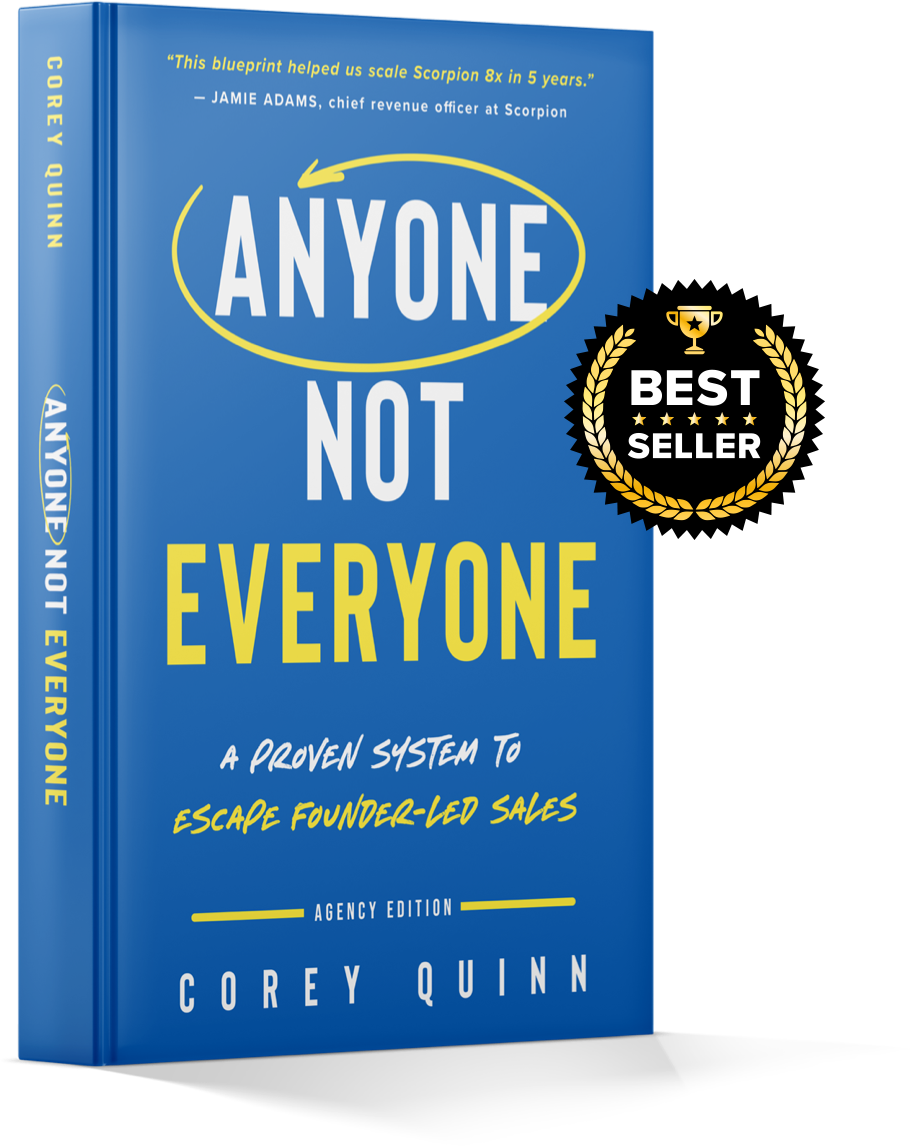
Corey helps founder-led agencies scale through Deep Specialization™ and programmatic M&A. Former CMO of Scorpion ($20M to $200M). Author of "Anyone, Not Everyone."