How to Build an Agency That Can Operate Without Its Founder
Corey Quinn
Founder, Deep Specialization™
A founder-free agency isn't a fantasy for someone else's business. Here's the practical path to building leadership, systems, and sales that don't depend on you.
Your agency can't scale past you. That's math, not an insult. Every hour of growth that has to route through your calendar caps how big and how valuable the business can get.
Building an agency that runs without its founder doesn't mean stepping away entirely. It means removing yourself as the single point of failure in sales, client relationships, and decision-making, so the business is an asset you own instead of a job you can't quit.
The three places founder dependence lives
Sales. If new business depends on your personal reputation and relationships, revenue is capped at your bandwidth and disappears the moment you're not available. The fix is a documented, repeatable sales process a hired seller can run, built around your specialization rather than your personal network.
Client relationships. If clients stay because they trust you specifically, that trust doesn't transfer to a buyer, and it doesn't scale to new clients you haven't personally met. The fix is named account leads with real authority and a direct relationship with clients, not a layer that escalates every real decision back to you.
Decisions. If every meaningful call (hiring, pricing, strategy) routes through you, there's no leadership team a buyer, or you, can rely on. The fix is a real leadership layer with the authority to make decisions, not just the responsibility to execute yours.
The same maturity model that drives growth
This maps directly to the agency maturity model: referrals → inbound → outbound → M&A. Each stage requires less founder-dependent selling and more system-dependent selling. An agency that has outgrown founder-led referral selling and built a real outbound engine has, almost by definition, already reduced a meaningful share of its founder dependence.
Common mistakes
Founders hire a single senior person and call it done. Real founder independence requires the process and systems underneath that person, not just a title. If the new hire still has to check with you on everything, you've added a salary, not removed the dependence.
Recommended next steps
Take one week and track every decision, client conversation, and sales touchpoint that came through you personally. That list is your roadmap: everything on it is a candidate to delegate, document, or systematize.
FAQ
Is this realistic for a smaller agency, under $5M in revenue?
Yes, and it's easier to start early than to retrofit later. Even a small agency can build a documented sales process and a named account lead structure well before it can afford a full leadership team. Start with the highest-dependence item, not the biggest title.
How do I know if I've actually reduced founder dependence, or just added people?
Test it directly. Take a real week off, with no check-ins, and see what happens to sales, client relationships, and decisions. If nothing breaks, you've made progress. If everything still routes to you through habit, the org chart changed but the dependence didn't.
Does this mean I have to leave the business eventually?
No. Plenty of founders build a founder-independent agency and choose to stay, running it as CEO with real leverage instead of as the bottleneck. The value is that the business no longer requires you, whether or not you leave.
How long does this typically take?
Most founders underestimate it. Sales process maturity, account leadership, and a real decision-making layer take eighteen months to a few years to build convincingly, not months. Start well before you think you need to.
About Corey Quinn
Founder, Deep Specialization™
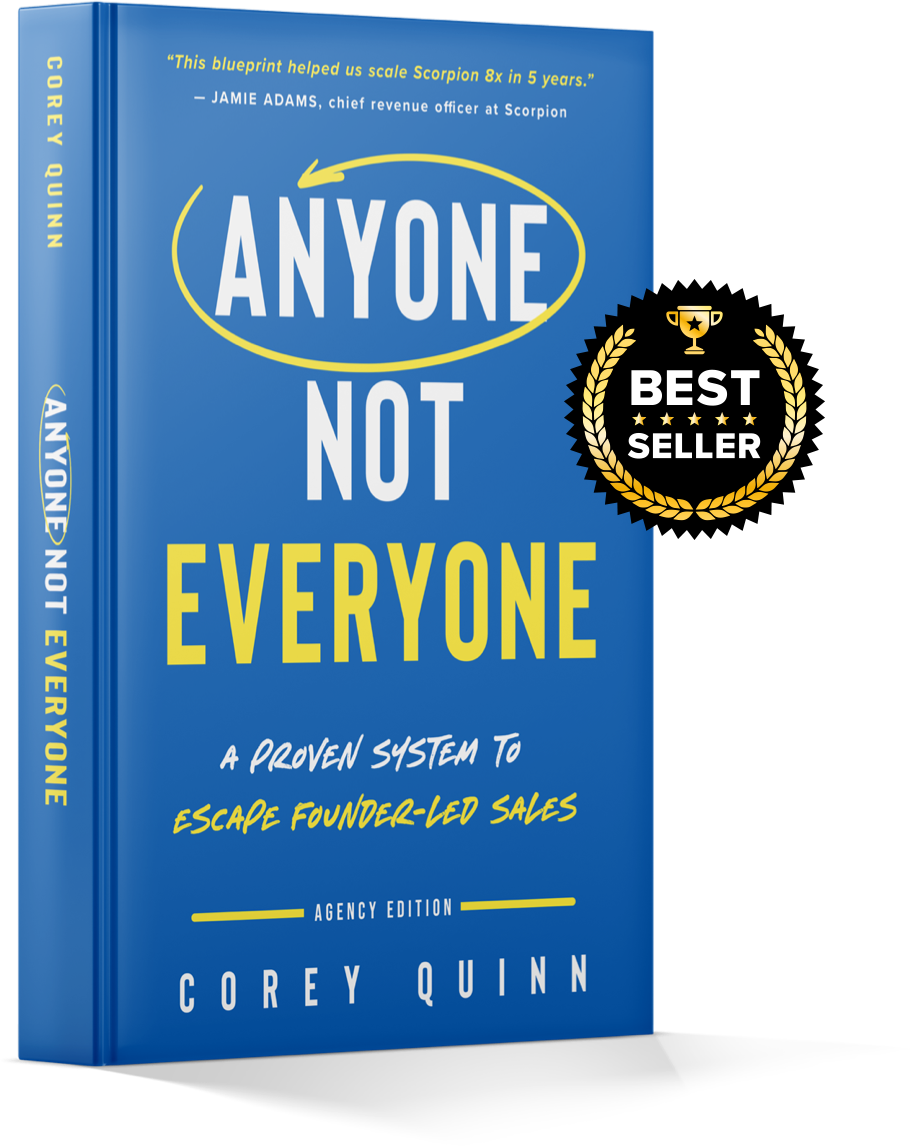
Corey helps founder-led agencies scale through Deep Specialization™ and programmatic M&A. Former CMO of Scorpion ($20M to $200M). Author of "Anyone, Not Everyone."