You don't have a sales playbook
Corey Quinn
Founder, Deep Specialization™
"We have a sales playbook." Then I ask to see it. Learn why a list of questions and templates isn't a system, and why the choreography is what actually closes deals.
"We have a sales playbook."
I hear this all the time. Then I ask to see it.
It's usually a Google Doc with a list of qualifying questions, some email templates, and a slide deck. Maybe a pricing sheet.
Here's what it's missing: the choreography.
Great sales isn't about the words you say. It's about the sequence you say them in, the signals you read, and the adjustments you make along the way.
A playbook that says "Ask about their goals" is useless.
A system that says "Earn trust first. Diagnose second. Prescribe last, and never out of order"—that's choreography.
One produces a random conversation. The other produces a 20-35% close rate regardless of who's running it.
Playbooks document ingredients.
Systems document the recipe.
If your sales process only works when you run it, you don't have a system yet.
CQ
P.S. In March, I'm launching the Founder-Free Sales System for agency founders ready to stop being their own best salesperson. Details here:https://www.coreyquinn.com/founder-free-sales
Frequently Asked Questions
Why isn't a typical sales playbook, a Google Doc with qualifying questions and templates, actually a system?
Because it documents ingredients, the questions to ask and materials to use, without documenting the choreography: the sequence, the signals to read, and the adjustments to make along the way.
What does "choreography" actually mean in the context of a sales process?
The specific order and logic behind a sales conversation, like "earn trust first, diagnose second, prescribe last, and never out of order," rather than a loose list of things to potentially bring up during a call.
Why does a vague instruction like "ask about their goals" fail to produce consistent results?
Because it leaves the actual sequencing and judgment entirely up to whoever is running the call, producing a random conversation rather than a repeatable, structured one.
What's the real difference between a playbook and a system, according to this framing?
A playbook documents ingredients, a system documents the recipe. One lists what could be used, the other specifies exactly how and when to use it to reliably produce a result.
What's the actual test for whether a sales process qualifies as a real system?
Whether it only works when the founder personally runs it. If results depend entirely on one specific person's execution, it hasn't yet been systematized into something repeatable by anyone else.
About Corey Quinn
Founder, Deep Specialization™
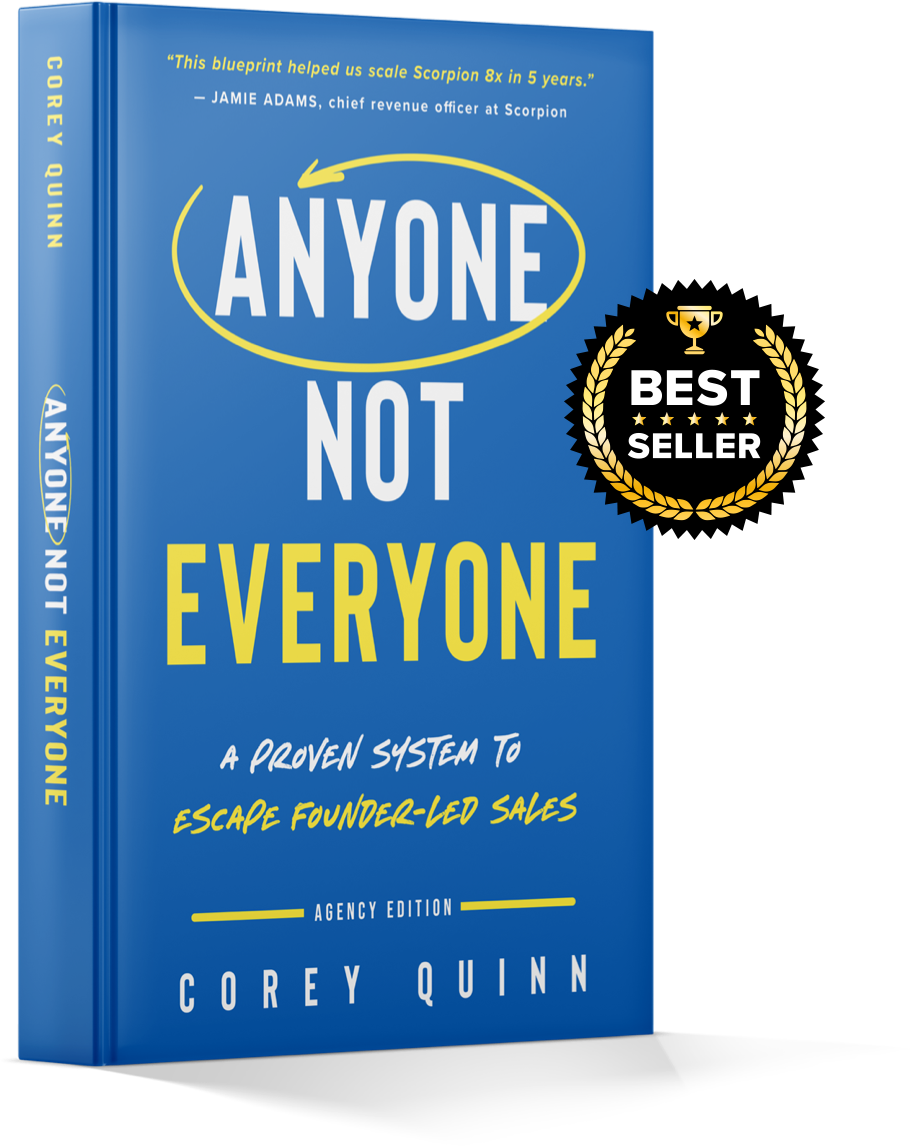
Corey helps founder-led agencies scale through Deep Specialization™ and programmatic M&A. Former CMO of Scorpion ($20M to $200M). Author of "Anyone, Not Everyone."