Why Should I Trust You?
Corey Quinn
Founder, Deep Specialization™
"Why should I trust you?" Every cold prospect is silently asking this in the first few minutes. Learn why naming their problems before they do wins faster than any pitch.
"Why should I trust you?"
Every cold prospect is silently asking this in the first few minutes of a sales call.
Most salespeople answer by gushing about themselves. Their credentials. Their services. Their process.
The prospect nods politely while thinking: "Is this the same pitch you give everyone?"
The fastest way to earn trust isn't talking about yourself.
It's naming their problems before they do.
Early in a call, share exactly three business-level problems the prospect is likely experiencing.
Not your services. Not features.
Three expensive, painful problems in their language, not yours.
Short phrases. Three to seven words. The kind of thing that keeps a founder up at night.
Then stop talking and ask: "Which of these three sound familiar?"
The prospect leans in. They pick one. Sometimes all three. Now they're not evaluating you. They're talking about themselves.
That's not charisma. That's choreography.
Frequently Asked Questions
Why does gushing about credentials and services actually fail to build trust on a cold call?
Because the prospect nods politely while wondering if it's the same pitch given to everyone, generic self-promotion doesn't answer their silent question of "why should I trust you?"
What's the fastest way to actually earn trust early in a sales call?
Naming their problems before they do, not services or features, but three expensive, painful problems described in their own language, the kind of thing that keeps a founder up at night.
What should these three problems actually sound like when stated on a call?
Short phrases, three to seven words each, specific enough to feel immediately recognizable rather than vague or generic descriptions of common business challenges.
What happens after naming the three problems and asking "which of these sound familiar?"
The prospect leans in and starts talking about themselves, sometimes picking one problem, sometimes all three, shifting the conversation away from evaluating the seller and toward their own actual situation.
Why is this described as "choreography" rather than charisma?
Because it's a specific, repeatable sequence, naming problems, then asking a direct question, that produces the same trust-building effect regardless of who's running the call, not a personality trait that only some salespeople naturally have.
About Corey Quinn
Founder, Deep Specialization™
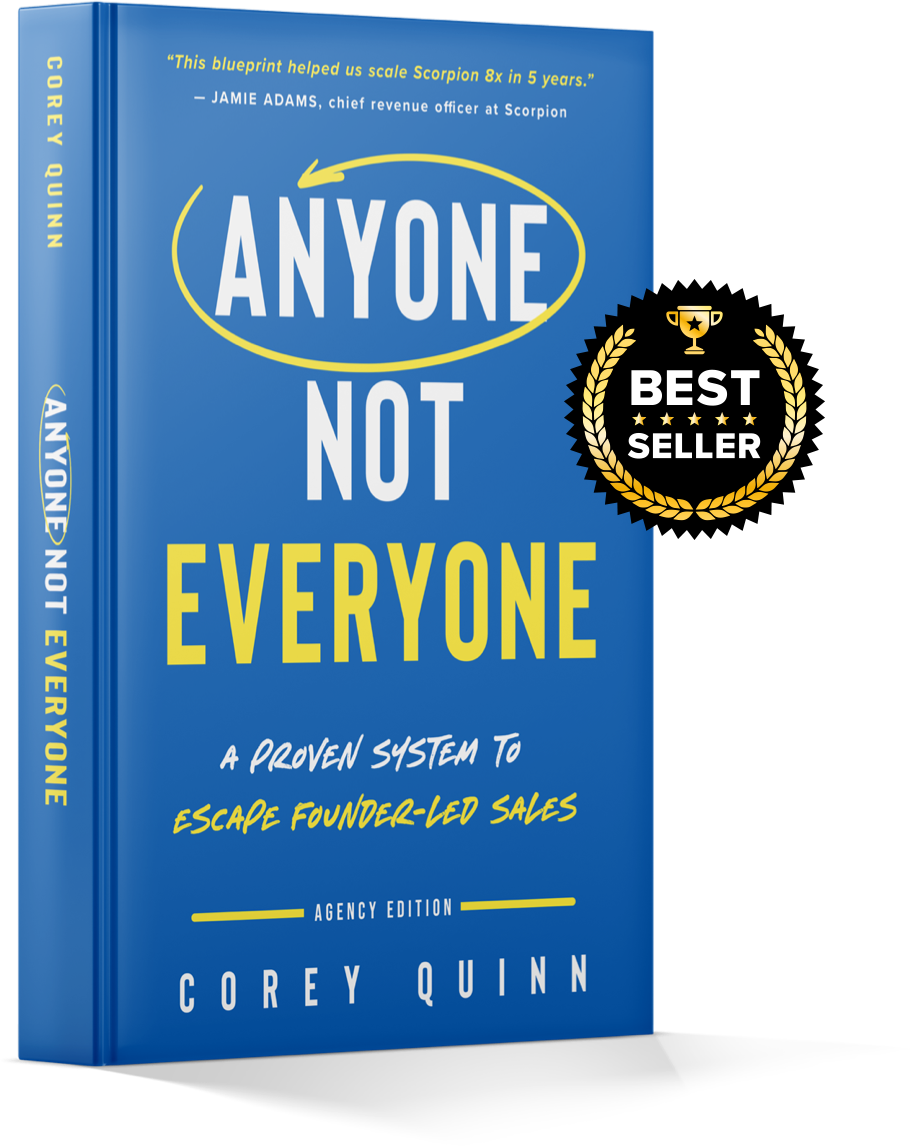
Corey helps founder-led agencies scale through Deep Specialization™ and programmatic M&A. Former CMO of Scorpion ($20M to $200M). Author of "Anyone, Not Everyone."