Don't discount like a rookie, do this instead
Corey Quinn
Founder, Deep Specialization™
Use this power-shift framework instead of cutting prices...
Your discount strategy is killing your deals.
Here's what I've learned from 20+ years in sales:
1/ The Psychology
Instant discount = Your price was fake
Asked-for discount = Buying signal
Negotiated discount = Value anchor
2/ The Framework
Wrong:
"I can offer 20% off"
Right:
"What else besides price do you need to make a decision?"
3/ The Leverage Points
Contract length
Payment terms
Sign-by date
Each = bargaining chip
4/ The Power Move
"I can definitely discuss pricing flexibility. But first - besides price, what else would prevent us from moving forward today?"
Then shut up and listen.
5/ Common Mistakes
Discounting before value demo
No time constraints
Multiple discount rounds
Zero leverage asks
Your prospects smell desperation.
6/ The Decision Tree
Price objection comes up?
Follow this flow:
1. Value confirmation
2. Non-price blockers
3. Leverage identification
4. Time-bound offer
5. Clear commitment ask
Here's the thing...
Discounts don't close deals.
Leverage does.
Remember - amateurs cut price
Pros trade value
CQ
Frequently Asked Questions
Why does offering an instant discount actually hurt credibility?
Because it signals the original price wasn't real to begin with. If a discount comes without any resistance or ask, the prospect learns the price was never firm in the first place.
What's the difference between an instant discount and a negotiated one?
An instant discount just gives ground immediately, while a negotiated discount, tied to something traded in return, acts as a value anchor. The negotiated version protects the perceived worth of the price.
What should be asked instead of immediately offering a discount?
"What else besides price do you need to make a decision?" That question surfaces real blockers instead of assuming price is the only issue and jumping straight to cutting it.
What are examples of leverage points to trade for a discount?
Contract length, payment terms, and sign-by dates. Each one gives something back in exchange for flexibility on price, rather than giving the discount away for nothing.
What's the biggest mistake to avoid when a price objection comes up?
Discounting before value has even been demonstrated. Without confirming value and surfacing non-price blockers first, a discount just becomes a reflex instead of a deliberate trade.
About Corey Quinn
Founder, Deep Specialization™
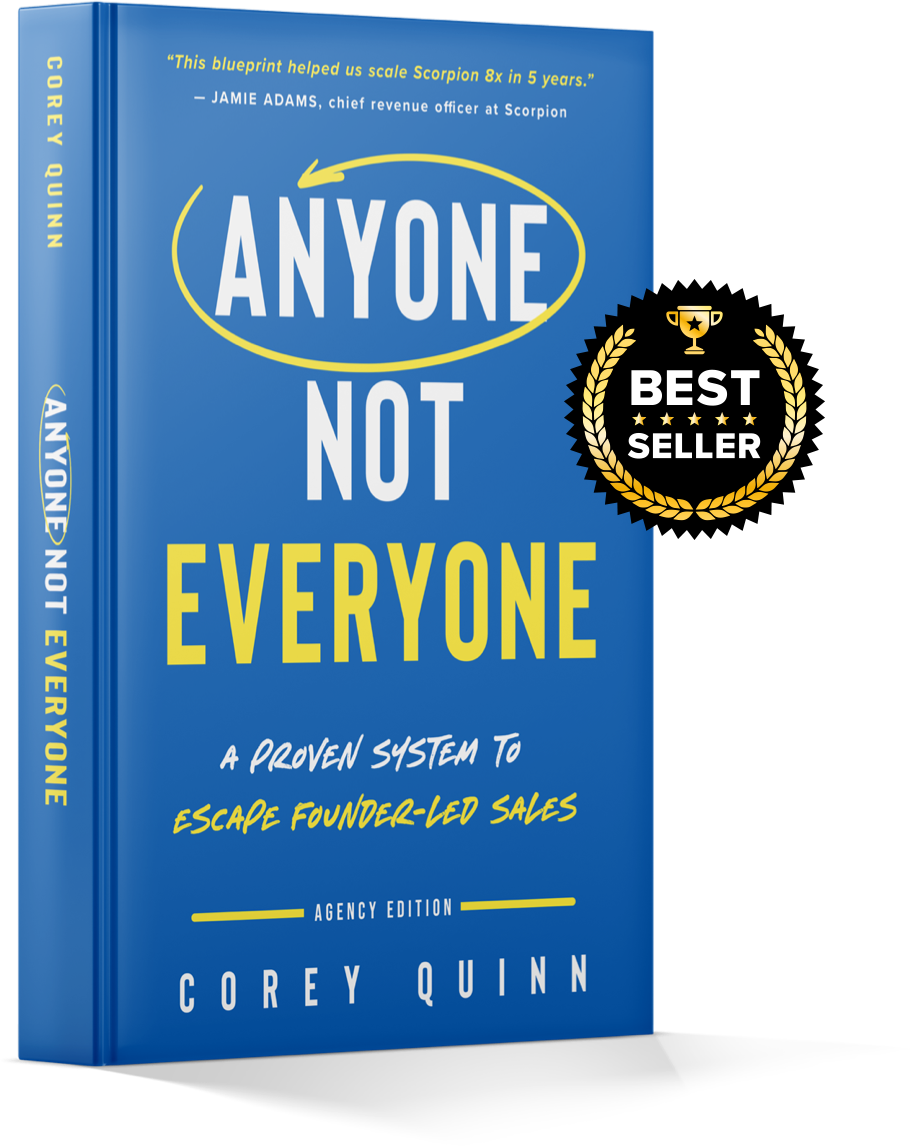
Corey helps founder-led agencies scale through Deep Specialization™ and programmatic M&A. Former CMO of Scorpion ($20M to $200M). Author of "Anyone, Not Everyone."